
Categories
Home Buying Timeline: Pre-Approval to Closing DayPublished August 25, 2026
Home Buying Timeline: Pre-Approval to Closing Day

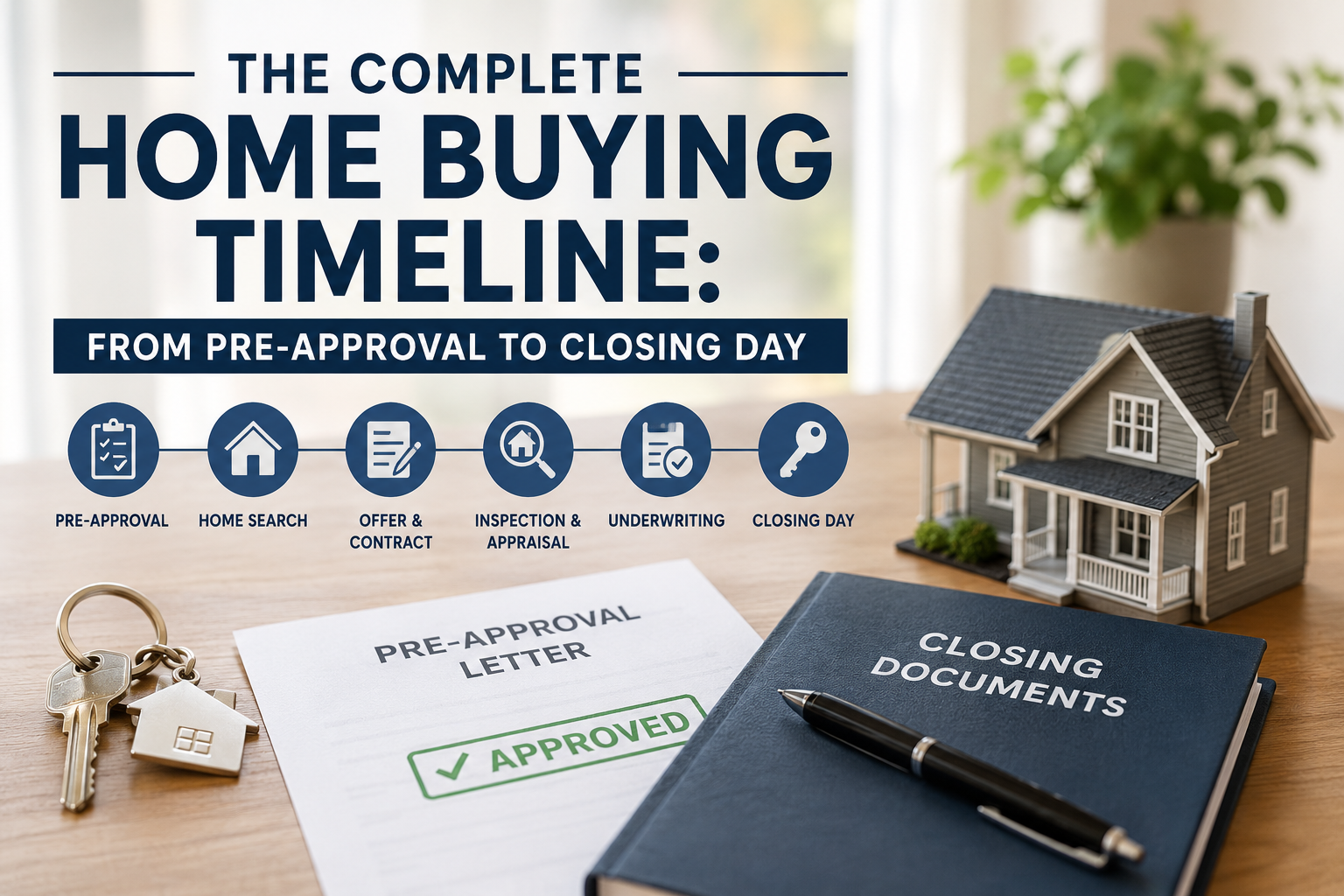
The Complete Home Buying Timeline: From Pre-Approval to Closing Day
The home buying timeline usually starts with financial preparation and pre-approval, then moves through home search, offer, contract, attorney review, inspection, appraisal, underwriting, final walkthrough, and closing day. Buying a home can feel complicated when you look at the entire process at once.
There are lenders, showings, contracts, inspections, appraisals, attorneys, deadlines, title work, insurance, paperwork, and finally the closing itself.
For first-time buyers, and even buyers who have not moved in years, it can be hard to know what happens next.
The good news is simple: home buying becomes much easier when you break it into stages.
While every transaction is different, most home purchases follow a similar path. Understanding that timeline before you begin can help you prepare financially, recognize potential risks, and make decisions with more confidence.
Here is a practical look at the home buying process from pre-approval through closing day, especially if you are buying a home in Northern Illinois, McHenry County, Lake County, or nearby Illinois communities.
Why should buyers review their finances before touring homes?
Buyers should review their finances before touring homes because a home purchase involves more than the monthly mortgage payment. You need to understand your savings, credit, debt, down payment, closing costs, moving expenses, and comfort level before choosing a price range.
Before looking at homes, review the money you may need for:
- Down payment
- Earnest money
- Home inspection
- Appraisal
- Closing costs
- Attorney fees
- Moving expenses
- Initial repairs or improvements
- Homeowners insurance
- Emergency savings after closing
This is also the right time to review your credit, income, debts, and available savings.
The goal is not simply to find the maximum loan amount you can qualify for. The goal is to choose a housing budget that supports your life after closing.
Key takeaway: A smart home search starts with a comfortable budget, not just a maximum approval number.
Image Suggestion: A buyer reviewing savings, debt, monthly budget, and home buying costs before starting the search.
Alt Text: “Buyer reviewing finances before starting the home buying timeline.”
When should buyers get pre-approved for a mortgage?
Buyers should get pre-approved before seriously touring homes because pre-approval helps define the price range and shows sellers that financing has already been reviewed. This is one of the most important early steps for buyers using a mortgage.
During pre-approval, a lender may review:
- Income and employment
- Credit history
- Monthly debts
- Assets and savings
- Available down payment
- Loan program options
- Estimated payment range
The Consumer Financial Protection Bureau explains that a pre-approval letter is a statement from a lender that it is tentatively willing to lend money up to a certain amount, although it is not a guaranteed loan offer.
A strong pre-approval can help you shop with more confidence. It can also make your offer more credible when a seller is comparing multiple buyers.
Important: Pre-approval is not the same as final loan approval. Your finances will continue to be reviewed during the transaction.
Avoid making major financial changes without talking to your lender, such as:
- Opening new credit cards
- Financing a car or furniture
- Making large unexplained deposits
- Changing jobs
- Increasing debt
- Missing payments
Key takeaway: Pre-approval helps you shop smarter, but final loan approval still comes later.
Image Suggestion: A buyer holding a mortgage pre-approval letter before touring homes.
Alt Text: “Mortgage pre-approval before buying a home in Northern Illinois.”
How should buyers define what they need in a home?
Buyers should define what they need in a home by separating must-have features, preferences, and location priorities before showings begin. Clear priorities help reduce emotional decisions and make the search more focused.
Start with three categories.
Needs
These are features that affect the functionality of the home.
Examples may include:
- Number of bedrooms
- Number of bathrooms
- Home office space
- Garage requirements
- First-floor living
- Property size
- Accessibility considerations
- Commute requirements
- School or location needs
Preferences
These are features you would enjoy but may be willing to compromise on.
Examples may include:
- Updated kitchen
- Finished basement
- Fireplace
- Larger yard
- Specific style
- Extra storage
- Outdoor entertaining space
Location considerations
Think about your daily life, not just the house.
Consider:
- Work commute
- Transportation
- Shopping
- Restaurants
- Medical services
- Parks
- Recreation
- Community amenities
- Family proximity
- Property taxes
- HOA or association fees
The right home should fit your routine, not only your wish list.
Key takeaway: Know the difference between what you need, what you want, and what would simply be nice to have.
Image Suggestion: A buyer checklist divided into needs, preferences, and location priorities.
Alt Text: “Home buyer needs and wants checklist before touring homes.”
What should buyers look for when touring homes?
Buyers should look beyond staging and finishes when touring homes and focus on location, layout, condition, systems, maintenance, and long-term fit. Cosmetic features can distract from issues that are harder or more expensive to change.
During showings, pay attention to:
- Location
- Lot characteristics
- Floor plan
- Foundation
- Roof condition
- Windows
- Plumbing
- Electrical systems
- Heating and cooling equipment
- Drainage
- Overall maintenance
- Storage
- Natural light
- Traffic or noise
- Signs of moisture or deferred maintenance
A beautiful kitchen can be updated again someday. A poor location usually cannot.
The goal is not to find a perfect property. The goal is to understand what you are buying and decide whether the home’s condition, location, functionality, and price make sense for your situation.
Key takeaway: Look at both the charm and the fundamentals before getting emotionally attached.
Image Suggestion: A buyer walking through a home while checking layout, windows, mechanical systems, and maintenance details.
Alt Text: “Buyer touring a home and looking beyond cosmetic finishes.”
Why should buyers review comparable sales before making an offer?
Buyers should review comparable sales before making an offer because the asking price only shows what the seller wants, not necessarily what the home is worth. Comparable sales help buyers understand local value and create a stronger offer strategy.
Before submitting an offer, review:
- Recent comparable sales
- Current competing listings
- Property condition
- Days on market
- Previous price changes
- Local inventory
- Buyer competition
- Seller circumstances, when known
- Appraisal risk
- Property features and updates
The Consumer Financial Protection Bureau notes that appraisals generally compare the home being purchased with similar home sales from the same area. That is one reason comparable sales matter before the offer is written.
Your real estate agent can help you understand what recent sales suggest, how the home compares with current competition, and whether the list price is supported by the market.
Key takeaway: Market data turns an emotional decision into a more informed offer strategy.
Image Suggestion: A buyer and real estate agent reviewing comparable sales before submitting an offer.
Alt Text: “Buyer reviewing comparable sales before making a home offer.”
What should be included in a real estate offer?
A real estate offer should include more than the purchase price. It may also address earnest money, financing, closing date, inspection terms, appraisal terms, attorney review, credits, personal property, and other contract conditions.
Depending on the transaction, your offer may include:
- Purchase price
- Earnest money
- Financing terms
- Down payment
- Proposed closing date
- Inspection provisions
- Attorney review terms
- Appraisal considerations
- Personal property
- Seller credits or concessions
- Closing cost assistance, if applicable
- Contingencies
- Possession timing
- Other contract terms
The strongest offer is not automatically the highest offer.
Sellers may also consider:
- Financing strength
- Closing timeline
- Contingencies
- Certainty
- Earnest money
- Appraisal risk
- Inspection terms
- Overall contract clarity
Your offer should reflect both market conditions and the amount of risk you are comfortable accepting.
Key takeaway: A strong offer balances price, terms, timing, and protection.
Image Suggestion: A buyer reviewing offer terms with a real estate professional before submitting the contract.
Alt Text: “Buyer preparing a real estate offer with price financing and contingencies.”
What happens after you submit an offer?
After you submit an offer, the seller may accept it, reject it, counter it, or request changes to certain terms. Negotiation can involve price, timing, credits, repairs, personal property, or other contract details.
After receiving your offer, the seller may:
- Accept the offer
- Reject the offer
- Make a counteroffer
- Ask for changes
- Request clarification
- Compare your offer with others
Negotiations may involve:
- Purchase price
- Closing date
- Seller credits
- Included appliances or fixtures
- Earnest money
- Inspection terms
- Appraisal terms
- Possession timing
- Other contract provisions
Once both sides agree and the required documents are signed, the property moves into the next stage of the transaction.
An accepted offer is exciting, but the home is not yours yet. Inspection, appraisal, financing, title work, and closing still need to happen.
Key takeaway: Contract acceptance is a major milestone, but it is not the finish line.
Image Suggestion: A buyer receiving notice that their offer has been accepted.
Alt Text: “Buyer offer accepted during the home buying timeline.”
What is attorney review in an Illinois home purchase?
Attorney review is the stage when a real estate attorney may review the signed contract, discuss legal concerns, request modifications, and help protect the buyer’s interests within the terms and deadlines of the agreement. In many Illinois residential transactions, attorneys play an important role after contract acceptance.
During attorney review, your attorney may help with:
- Contract language
- Legal questions
- Inspection-related terms
- Modification requests
- Title issues
- Closing preparation
- Deadline awareness
- Buyer protections under the contract
Because contracts create legal obligations, buyers should read deadlines carefully and communicate promptly with their attorney, lender, and real estate agent.
Your real estate agent does not replace an attorney. Your attorney does not replace your lender or inspector. Each professional has a different role.
Key takeaway: Attorney review helps buyers understand and address legal contract details before moving deeper into the transaction.
Image Suggestion: A buyer reviewing an Illinois real estate contract with an attorney.
Alt Text: “Illinois home buyer attorney review after offer acceptance.”
Why is the home inspection important?
The home inspection is important because it gives buyers more information about the property’s condition before closing. It can help identify concerns involving safety, function, repairs, maintenance, and future costs.
A professional home inspector may evaluate accessible areas and systems such as:
- Roof
- Foundation
- Electrical system
- Plumbing
- Heating and cooling
- Windows and doors
- Attic and insulation
- Basement or crawlspace
- Exterior drainage
- Appliances
- Radon, when applicable
- Well, when applicable
- Septic system, when applicable
- Other specialized systems
HUD explains that a home inspection provides more detailed information about a home’s physical condition than an appraisal, and it is generally in the buyer’s best interest to complete the inspection as soon as possible if they want one.
The purpose of inspection is not to create a list of every minor imperfection. It is to understand the property and identify issues that could materially affect safety, function, value, or future expenses.
Key takeaway: The inspection helps buyers understand what they are buying before closing.
Image Suggestion: A home inspector checking an electrical panel while a buyer takes notes.
Alt Text: “Home inspection during the Illinois home buying process.”
What happens during the mortgage approval process?
During the mortgage approval process, the lender continues reviewing the buyer’s finances, documents, employment, credit, assets, and the property before issuing final approval. Pre-approval is only the beginning.
Your lender may request updated documents such as:
- Pay stubs
- Bank statements
- Tax documents
- Employment verification
- Proof of insurance
- Explanations for deposits or transactions
- Updated credit information
- Additional loan conditions
Respond quickly to lender requests. Delays in documentation can slow down the entire transaction.
During this time, avoid major financial changes unless your lender confirms they are acceptable.
Do not assume silence means everything is finished. Continue checking your email and staying in contact with your lender, attorney, and real estate agent.
Key takeaway: The loan process continues until final approval and closing are complete.
Image Suggestion: A buyer uploading lender documents during the mortgage approval process.
Alt Text: “Buyer completing mortgage approval documents before closing.”
What is the appraisal, and why does it matter?
An appraisal is a written opinion of the property’s value, and it matters because the lender may use it to confirm that the home supports the mortgage loan. If the appraised value supports the purchase price, the loan process can continue more smoothly.
The Consumer Financial Protection Bureau explains that an appraisal is a written document showing an opinion of how much a property is worth. When you borrow money to buy a home, your lender may need a new appraisal and may require you to pay for it.
An appraiser may consider:
- Property condition
- Size
- Features
- Location
- Recent comparable sales
- Market conditions
- Lot and improvements
If the appraisal is lower than the contract price, the buyer and seller may need to review options based on the contract and financing terms.
Possible options may include:
- Renegotiating the price
- Buyer bringing additional funds
- Seller and buyer splitting the difference
- Requesting a reconsideration through the lender
- Canceling, if allowed by the contract
Key takeaway: Careful offer pricing can reduce appraisal risk later.
Image Suggestion: An appraiser measuring the exterior of a home before preparing the appraisal report.
Alt Text: “Home appraisal during the mortgage approval process.”
What happens during title work and final underwriting?
During title work and final underwriting, the title company, attorneys, and lender review ownership, title matters, borrower documents, and property information before closing. Much of this work happens behind the scenes.
Title work may involve reviewing public records for:
- Ownership history
- Liens
- Unreleased mortgages
- Judgments
- Taxes
- Easements
- Legal descriptions
- Other matters affecting transfer
At the same time, underwriting is the lender’s detailed review of the borrower and the property before final loan approval.
The lender may request additional documents during this stage. Respond quickly and avoid assuming that no news means everything is complete.
Key takeaway: Title and underwriting work help confirm that the transaction can move toward closing.
Image Suggestion: A closing professional reviewing title documents while a lender reviews underwriting conditions.
Alt Text: “Title work and final underwriting before closing on a home.”
When should buyers secure homeowners insurance?
Buyers should secure homeowners insurance early in the closing process because lenders usually require insurance before closing. Waiting until the last minute can create stress or delays.
Insurance availability and pricing can vary based on:
- Property location
- Construction type
- Prior claims
- Roof age
- Property condition
- Coverage limits
- Deductible
- Flood or special risk considerations
- Insurance company requirements
Getting quotes earlier can help you understand the actual cost of owning the home.
For some properties, additional coverage or research may be appropriate, especially if the home has waterfront exposure, floodplain considerations, older systems, or unique features.
Key takeaway: Insurance is part of affordability, not just a closing requirement.
Image Suggestion: A buyer comparing homeowners insurance quotes before closing.
Alt Text: “Buyer securing homeowners insurance before closing day.”
What final numbers should buyers review before closing?
Buyers should review the final closing numbers carefully, including loan terms, monthly payment, taxes, insurance, closing costs, credits, down payment, and cash required to close. If something looks different than expected, ask questions before closing day.
Review:
- Purchase price
- Loan amount
- Interest rate
- Estimated monthly payment
- Taxes
- Insurance
- Closing costs
- Credits
- Down payment
- Cash required for closing
- Prepaid expenses
- Escrow items
- Loan terms
For most covered mortgage loans, the CFPB states that the lender must provide the Closing Disclosure at least three business days before closing, giving buyers time to compare final loan terms and costs with the earlier Loan Estimate.
This is your opportunity to review the financial details before signing.
Key takeaway: Do not wait until the closing table to ask about numbers you do not understand.
Image Suggestion: A buyer reviewing the Closing Disclosure and final cash-to-close amount.
Alt Text: “Buyer reviewing final closing numbers before closing day.”
What happens during the final walkthrough?
The final walkthrough is the buyer’s opportunity to confirm that the property is generally in the expected condition before closing. It is not a second full inspection.
During the walkthrough, buyers may verify that:
- The property has not been materially damaged
- Agreed-upon personal property remains
- Seller belongings have been removed as required
- Negotiated repairs were addressed, when applicable
- Major systems appear to be operating as expected
- Included appliances remain
- The home is ready for possession under the contract
If something unexpected is discovered, notify your real estate agent and attorney promptly.
The final walkthrough is usually completed shortly before closing, often the day before or the day of closing depending on local practice and scheduling.
Key takeaway: The final walkthrough helps confirm that the home is ready before ownership transfers.
Image Suggestion: A buyer and real estate agent walking through an empty home before closing.
Alt Text: “Final walkthrough before closing on a home.”
What happens on closing day?
Closing day is when the buyer signs final legal and financial documents, funds are transferred, documents are completed, and ownership transfers according to the transaction. Once closing is complete, possession happens based on the contract.
At closing, buyers may review and sign documents related to:
- Mortgage
- Loan terms
- Property ownership
- Taxes
- Title
- Insurance
- Closing costs
- Escrow accounts
- Required disclosures
The CFPB explains that before closing on a mortgage, buyers can expect to receive documents required by state and federal law and contractual documents, and it offers resources to help buyers review closing documents.
Once documents are signed, funds are confirmed, and the transaction is completed, the keys are yours according to the possession terms in the contract.
Key takeaway: Closing day is the final step where the home purchase becomes official.
Image Suggestion: A buyer signing closing documents with house keys on the table.
Alt Text: “Closing day for a home buyer in Northern Illinois.”
How long does the home buying process take?
The home buying process can take a few weeks to several months or longer depending on how quickly you find the right home and how smoothly financing, inspections, appraisal, title work, and closing move forward. There is no single timeline that fits every buyer.
Your timeline may depend on:
- Financing type
- Time needed to find the right home
- Property condition
- Inspection findings
- Appraisal results
- Attorney review
- Contract terms
- Title issues
- Seller circumstances
- Lender processing
- Negotiated closing date
- Buyer readiness
Rather than focusing only on speed, focus on staying organized at each stage.
Key takeaway: The best timeline is one that protects your budget, your contract deadlines, and your decision-making confidence.
Image Suggestion: A home buying timeline graphic showing pre-approval, search, offer, inspection, appraisal, underwriting, walkthrough, and closing.
Alt Text: “Complete home buying timeline from pre-approval to closing.”
How can buyers reduce surprises during the process?
Buyers can reduce surprises by preparing financially, getting pre-approved, reviewing market data, completing inspections, meeting deadlines, and communicating with their lender, attorney, and real estate agent. Not every issue can be avoided, but many can be addressed earlier with good preparation.
To reduce uncertainty:
- Review your budget before touring
- Get pre-approved early
- Understand monthly ownership costs
- Compare recent sales before offering
- Read contract deadlines carefully
- Complete inspections promptly
- Respond quickly to lender requests
- Secure homeowners insurance early
- Review closing numbers before closing day
- Ask questions whenever something is unclear
The goal is not to eliminate every possible complication. The goal is to recognize issues early enough to make informed decisions.
Key takeaway: Preparation does not guarantee a perfect transaction, but it can help you respond with confidence.
Image Suggestion: A buyer checklist showing budget, pre-approval, inspection, lender documents, insurance, and closing review.
Alt Text: “Buyer checklist to reduce surprises during the home buying process.”
How can an AI-Certified real estate agent help buyers from pre-approval to closing?
An AI-Certified real estate agent can help buyers stay organized by summarizing property notes, comparing homes, tracking questions, preparing checklists, and communicating next steps more clearly. The value is not just the technology. The value is a more organized and less stressful buying experience.
AI-supported tools may help buyers:
- Organize showing notes
- Compare home features
- Track must-haves and nice-to-haves
- Summarize buyer questions
- Prepare offer discussion points
- Organize inspection follow-up items
- Create clearer timelines
- Keep next steps easier to follow
Still, technology should support professional judgment, not replace it. A strong local agent brings market knowledge, negotiation experience, pricing insight, and practical guidance through the full buying process.
Key takeaway: Smart tools can support organization, but trusted local expertise guides the decisions.
Image Suggestion: An AI-Certified real estate agent helping a buyer review a home buying timeline on a tablet.
Alt Text: “AI-Certified real estate agent helping buyer from pre-approval to closing.”
What is the complete home buying checklist?
A complete home buying checklist helps buyers stay organized from financial preparation through closing day. Use it to understand the major steps and keep the process moving.
Use this checklist:
- Review your finances
- Estimate down payment and closing costs
- Check credit, income, debt, and savings
- Get pre-approved for financing
- Define needs, preferences, and location priorities
- Begin touring homes
- Look beyond cosmetic finishes
- Review comparable sales before offering
- Prepare and submit the offer
- Negotiate contract terms
- Move through attorney review, when applicable
- Complete the home inspection
- Continue the mortgage approval process
- Avoid major financial changes
- Prepare for appraisal
- Complete title and underwriting requirements
- Secure homeowners insurance
- Review final closing numbers
- Complete the final walkthrough
- Sign closing documents
- Receive keys based on contract terms
Key takeaway: A clear checklist turns a complicated process into manageable steps.
Image Suggestion: A printable home buying checklist from pre-approval to closing day.
Alt Text: “Complete home buying checklist from pre-approval to closing.”
Final thoughts: buying a home is easier with a clear plan
Buying a home is more than finding a property and signing a contract. It is a sequence of financial, legal, practical, and personal decisions that eventually lead to ownership.
You do not need to understand every part of the process before you begin.
You do need a clear plan, the right professionals around you, and the willingness to ask questions when something is unclear.
If you are considering buying a home in Northern Illinois, I am happy to help you understand the process, prepare for the decisions ahead, and build a strategy based on your specific goals.
Kevin K. Kalbach
Realty Executives Cornerstone
Phone: 815-321-4250
Success Starts with a Callback
Frequently Asked Questions
What is the first step in the home buying timeline?
The first step is reviewing your financial position before touring homes. This includes your budget, savings, credit, income, debts, down payment, closing costs, moving expenses, and emergency savings. Once you understand your finances, you can talk with a lender about pre-approval.
Is pre-approval the same as final mortgage approval?
No, pre-approval is not the same as final mortgage approval. A pre-approval letter shows that a lender is tentatively willing to lend up to a certain amount, but your finances and the property still need to be reviewed later. Final approval usually comes after underwriting, appraisal, insurance review, and required documentation.
When should I schedule a home inspection?
A home inspection is usually scheduled soon after the offer is accepted, based on the contract deadlines. HUD notes that it is generally in a buyer’s best interest to complete a home inspection as soon as possible if they want one. The inspection helps you better understand the home’s condition before closing.
What happens if the appraisal is lower than the purchase price?
If the appraisal is lower than the purchase price, the buyer and seller may need to review the contract and financing terms. Options may include renegotiating the price, the buyer bringing additional funds, requesting a reconsideration through the lender, or canceling if allowed by the contract. Your real estate agent, lender, and attorney can help you understand your options.
What should I review before closing day?
Before closing day, review your Closing Disclosure, loan terms, interest rate, monthly payment, taxes, insurance, closing costs, credits, down payment, and cash required to close. The CFPB states that lenders must provide the Closing Disclosure at least three business days before closing for most covered mortgage loans. Ask questions before signing if anything looks different than expected.
Internal Link Opportunities
Use these only if you have real live pages on your website:
- home buying timeline → Link to your buyer process guide
- buying a home in Northern Illinois → Link to your Northern Illinois buyer page
- mortgage pre-approval → Link to your pre-approval guide
- home inspection → Link to your inspection article
- appraisal → Link to your appraisal explainer
- closing day → Link to your closing process guide
- McHenry County home buyers → Link to your McHenry County buyer page
- Lake County home buyers → Link to your Lake County buyer page
- Success Starts with a Callback → Link to your contact page
Sources Used
- Consumer Financial Protection Bureau, Get a Preapproval Letter.
- Consumer Financial Protection Bureau, What Are Appraisals and Why Do I Need To Look at Them?
- Consumer Financial Protection Bureau, What Is a Closing Disclosure?
- Consumer Financial Protection Bureau, What Documents Should I Receive Before Closing on a Mortgage Loan?
- Consumer Financial Protection Bureau, Why Did I Receive Different Valuations During the Mortgage Loan Application Process?
- HUD Exchange, For Your Protection: Get a Home Inspection.
Get In Touch

Kevin Kalbach
Broker | Kevin Kalbach Group | Realty Executives Cornerstone
or another way