
Categories
How to Make Downsizing Feel Less OverwhelmingPublished August 10, 2026
How to Make Downsizing Feel Less Overwhelming

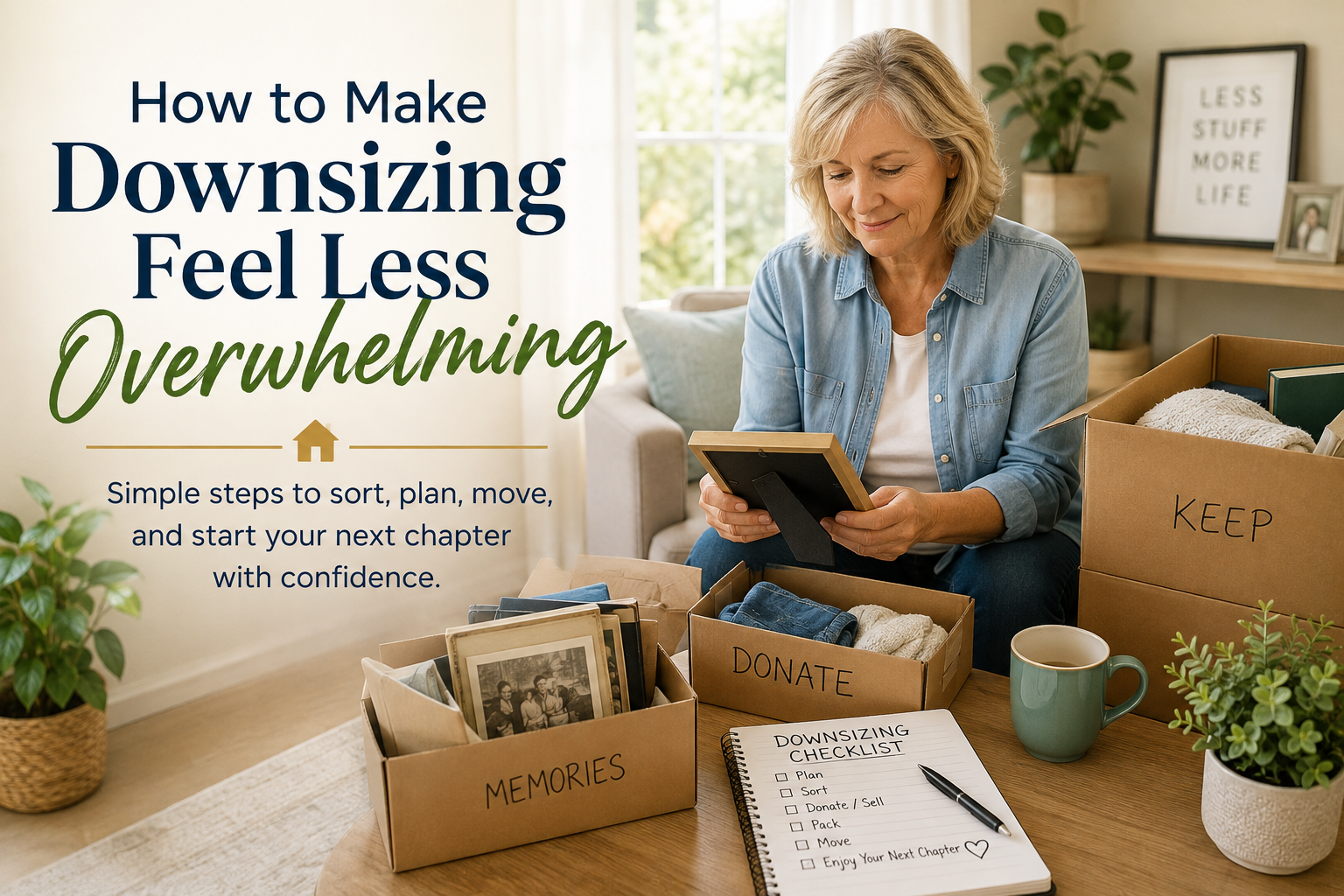
Blog Image Suggestion
Image Suggestion: A homeowner sorting keepsakes, photos, and moving boxes in a bright living room with a simple downsizing checklist nearby.
Alt Text: “Homeowner making downsizing less overwhelming with a simple moving checklist.”
How to Make Downsizing Feel Less Overwhelming
Downsizing feels less overwhelming when you slow the process down, start early, sort one space at a time, plan your next home, and focus on the life you want next. At first, downsizing can sound simple. Sell your current home, move into a smaller one, and bring fewer things with you.
Then reality shows up.
What should you keep? What should you donate? What happens to everything you collected over the years? How do you choose a smaller home that still feels like home?
Here is the good news: downsizing does not have to happen all at once.
When you break the process into small, practical steps, the move becomes easier to manage emotionally, financially, and physically. This guide will help you simplify the process, reduce stress, and take the next step with more confidence.
Why does downsizing feel so overwhelming?
Downsizing feels overwhelming because it combines several major decisions at once: selling a home, sorting belongings, choosing what to keep, planning a move, reviewing finances, and preparing emotionally for change. It is not just a real estate decision. It is a life transition.
Many people are not only moving from one home to another. They are leaving a place filled with memories, routines, and personal history.
Common reasons downsizing feels stressful include:
- Too many belongings to sort
- Uncertainty about where to move next
- Emotional attachment to the home
- Family opinions and expectations
- Financial questions
- Repairs and home preparation
- Moving logistics
- Fear of making the wrong decision
The solution is not to force yourself to finish everything quickly. The better approach is to make the process smaller and more organized.
Key takeaway: Downsizing becomes easier when you stop treating it like one huge project and start treating it like a series of small decisions.
Image Suggestion: A homeowner looking at moving boxes with a downsizing checklist on the table.
Alt Text: “Downsizing feels overwhelming before creating a simple plan.”
When should you start downsizing before a move?
You should start downsizing before you have to move because extra time reduces pressure and helps you make calmer decisions. Waiting until a moving date is close can turn every choice into an urgent one.
Start before there is a deadline, even if you are not ready to list your home yet.
Begin with one small space:
- One drawer
- One cabinet
- One closet
- One shelf
- One storage bin
- One corner of the garage
Ask yourself:
- Do I still use this?
- Would I move this to my next home?
- Does this item fit the life I want next?
- Would someone else benefit from it more?
- Is this item worth the space it takes?
You do not have to finish everything in one weekend. A little progress each week can make a big difference.
Key takeaway: Starting early gives you control. Waiting too long creates pressure.
Image Suggestion: A homeowner sorting one kitchen drawer before a downsizing move.
Alt Text: “Starting downsizing early by sorting one drawer at a time.”
How do you downsize one room at a time?
You downsize one room at a time by choosing one space, creating simple categories, and finishing that area before moving to the next. This makes the project feel smaller and easier to complete.
Looking at the entire house and thinking, “I have to go through all of this,” can make anyone feel stuck.
So make the project smaller.
Start with an easier room such as:
- Guest bedroom
- Pantry
- Linen closet
- Bathroom
- Laundry room
- Coat closet
- Small storage area
Use simple categories:
- Keep
- Donate
- Give to family
- Sell
- Recycle
- Throw away
- Decide later
The “decide later” category can help, but use it carefully. If everything goes into that pile, you may simply move the stress to another day.
Key takeaway: One finished closet is better than five half-sorted rooms.
Image Suggestion: A closet being sorted into keep, donate, sell, and discard boxes.
Alt Text: “Sorting one room at a time during a downsizing move.”
Why should you think about your next home before sorting?
You should think about your next home before sorting because your future space should guide what you keep, sell, donate, or give away. Downsizing is easier when you know what kind of lifestyle you are moving toward.
Before deciding what to keep, think about where you may go next.
Do you want:
- Fewer stairs?
- A smaller yard?
- Less maintenance?
- A ranch-style home?
- A condo or townhome?
- A smaller single-family home?
- A rental?
- A 55-plus community?
- A home closer to family, shopping, restaurants, or medical care?
Also consider whether your next home will still work for you in the future. HUD describes older-adult home modifications as a way to support safety, accessibility, and the ability to age in place, which is a helpful reminder to consider mobility and safety before choosing your next home. (HUD Archives)
Instead of asking, “How can I fit everything I own into a smaller home?” ask, “What do I want my next home to feel like?”
That small shift can make letting go feel less like loss and more like progress.
Key takeaway: Your next home should support your next lifestyle, not just hold your old belongings.
Image Suggestion: A downsizer comparing a condo, ranch home, townhome, and smaller single-family home.
Alt Text: “Choosing a smaller home before downsizing belongings.”
How do you decide what to keep when downsizing?
You decide what to keep by focusing on what you use, love, need, and have space for in your next home. Downsizing does not mean getting rid of everything meaningful. It means making room for what matters most.
Some items are practical. Some are emotional. Some are both.
Keep items that:
- You use regularly
- Fit your next home
- Support your daily routine
- Carry strong meaning
- Are difficult or expensive to replace
- Make your new space feel like home
For sentimental items, give yourself extra time. Family photos, keepsakes, artwork, furniture, and special collections may carry years of memories.
You can also preserve memories without keeping every physical item.
Consider:
- Taking photos of children’s artwork
- Scanning old documents
- Creating digital albums
- Saving one item from a larger collection
- Giving meaningful pieces to family
- Creating a small memory box
- Writing down the story behind special items
Key takeaway: Downsizing is not about having the fewest things. It is about keeping the right things.
Image Suggestion: A homeowner placing meaningful photos and keepsakes into a memory box.
Alt Text: “Keeping meaningful items while downsizing a home.”
How can you avoid feeling guilty while decluttering?
You can avoid feeling guilty while decluttering by remembering that letting go of an item does not erase the memory, relationship, or season of life connected to it. You are making space for your next chapter, not rejecting your past.
Many downsizers feel guilt over items connected to family, gifts, travel, hobbies, or past stages of life.
You may think:
- Someone gave this to me
- I spent money on this
- This belonged to a family member
- I might need it someday
- My children may want it
- I should keep it because I have had it for years
But keeping everything can make your next home harder to live in.
A helpful question is: Would keeping this item improve my next home, or would it create more stress?
If the item does not fit your future space or lifestyle, it may be time to let it serve someone else.
Key takeaway: Letting go can be an act of care for your future self.
Image Suggestion: A homeowner holding a keepsake while sorting donation and family boxes.
Alt Text: “Downsizing sentimental items without feeling guilty.”
Should you ask family members what they want?
Yes, you should ask family members what they truly want before deciding what to keep, donate, or sell. Clear conversations can prevent assumptions, reduce stress, and help meaningful items go to the right people.
Many homeowners save furniture, dishes, collections, or keepsakes because they believe family members will want them.
Sometimes they do. Sometimes they do not.
Ask family members to identify specific items they want. Then set a clear pickup deadline.
Helpful tools include:
- Photos of items
- Labels
- A shared list
- A simple spreadsheet
- Pickup dates
- Group text updates
- Written notes for meaningful pieces
This keeps the process organized and avoids last-minute confusion.
Key takeaway: Ask early, be clear, and do not assume family members want everything.
Image Suggestion: Family members reviewing labeled furniture and keepsakes before a downsizing move.
Alt Text: “Family choosing items before a downsizing move.”
How do you measure progress when downsizing?
You measure progress by the decisions you make, not only by how much you throw away. Sorting one closet, choosing what matters, or creating a plan for one room is still real progress.
Downsizing is not a contest to see how empty you can make your house.
Your goal is to create a home and lifestyle that feel easier to manage.
Progress may look like:
- Clearing one drawer
- Donating one box
- Labeling family items
- Scheduling a donation pickup
- Measuring furniture
- Reviewing next-home options
- Calling a mover
- Asking your agent about home value
- Creating a small timeline
If you sort through one closet and remove only a few things, that still counts.
Key takeaway: Progress is not always dramatic. Sometimes it is one good decision at a time.
Image Suggestion: A small donation box beside a finished closet with open space.
Alt Text: “Small downsizing progress after sorting one closet.”
Who can help make downsizing easier?
Family, friends, professional organizers, movers, estate sale companies, donation services, financial advisors, tax professionals, and real estate professionals can all help make downsizing easier. You do not need to handle every step alone.
Downsizing can involve sorting, packing, donating, selling, repairing, moving, cleaning, and planning the sale of your current home.
Your support team may include:
- Family members
- Friends
- Professional organizer
- Senior move manager
- Estate sale company
- Donation service
- Moving company
- Cleaner
- Contractor or handyman
- Financial advisor
- Tax professional
- Real estate professional
When hiring movers, the FTC recommends checking registration, licenses, insurance, local address details, written estimates, and complaint history, especially when an interstate move is involved. (Consumer Advice)
A real estate professional can also help you understand how selling your current home and buying your next one can work together.
Key takeaway: The right help can reduce stress, protect your time, and prevent rushed decisions.
Image Suggestion: A homeowner meeting with a real estate professional, organizer, and family member to plan a downsizing move.
Alt Text: “Downsizing support team helping with sorting and moving plans.”
How do selling and buying fit into a downsizing plan?
Selling and buying fit into a downsizing plan by helping you decide whether to sell first, buy first, move temporarily, request extra time after closing, or coordinate both transactions together. The right approach depends on your finances, timeline, and housing options.
Questions to discuss early include:
- Should I sell before buying?
- Should I buy before selling?
- What could my current home sell for?
- What smaller homes fit my budget?
- How much preparation does my current home need?
- Can I avoid moving twice?
- Would temporary housing make sense?
- Can I request a longer closing or post-closing possession?
Selling first may give you a clearer budget, but you may need a place to live before buying. Buying first may make the move easier, but it may create the cost and stress of owning two homes at once.
Key takeaway: A downsizing plan should connect your current home sale with your next housing choice.
Image Suggestion: A timeline showing selling, buying, moving, and closing dates in a downsizing plan.
Alt Text: “Selling and buying timeline for a downsizing move.”
What financial and tax questions should downsizers ask?
Downsizers should ask financial and tax questions before selling because a smaller home does not automatically mean lower total costs. Selling costs, moving expenses, taxes, HOA fees, insurance, and future care needs can all affect the decision.
Ask:
- What might my current home sell for?
- What will I owe after selling costs?
- What will my next home cost monthly?
- Will I have HOA fees?
- What will property taxes and insurance be?
- Do I need storage or temporary housing?
- Could the home sale affect my taxes?
- Should I speak with a tax professional?
The IRS says qualifying homeowners may be able to exclude up to $250,000 of gain from the sale of a main home, or up to $500,000 for some married couples filing jointly. Eligibility rules apply, and IRS Publication 523 gives more detailed guidance. (IRS)
Key takeaway: Plan around net proceeds and future costs, not just the sale price.
Image Suggestion: A homeowner reviewing a downsizing budget, home value estimate, and future housing costs.
Alt Text: “Financial planning before downsizing and selling a home.”
How can you create a simple downsizing plan?
You can create a simple downsizing plan by setting small weekly goals instead of trying to solve everything at once. A short, realistic plan is better than a complicated checklist you never use.
Try this simple timeline:
Week 1: Sort one closet
Choose a low-emotion area and make a small start.
Week 2: Go through the garage or storage area
Remove duplicates, broken items, and things you no longer use.
Week 3: Ask family members what they want
Give them a clear deadline to choose and pick up items.
Week 4: Donate or sell things you no longer need
Schedule donation pickups or list a few items for sale.
Week 5: Start exploring next-home options
Look at smaller homes, condos, townhomes, rentals, or communities that fit your needs.
Week 6: Talk with a real estate professional
Learn what your current home may be worth and what preparation may be needed.
Key takeaway: A simple plan turns one big project into manageable steps.
Image Suggestion: A weekly downsizing calendar with small tasks listed for each week.
Alt Text: “Simple downsizing plan with weekly tasks.”
How do you prepare emotionally for downsizing?
You prepare emotionally for downsizing by giving yourself time to remember, say goodbye, and focus on what the next chapter can offer. Mixed feelings are normal, even when the move is the right decision.
A longtime home is more than walls and a roof.
It may be where you raised children, celebrated holidays, hosted family dinners, worked in the yard, welcomed grandchildren, or built decades of routines.
To make the emotional side easier, consider:
- Taking photos of each room
- Writing down favorite memories
- Hosting one final family gathering
- Creating a small photo book
- Saving a meaningful item from the home
- Walking through the neighborhood
- Sharing stories with family
- Giving yourself permission to feel sad and excited
Downsizing is not only about leaving something behind. It can also be about creating more time, comfort, freedom, and simplicity.
Key takeaway: Selling the home does not erase the life you built there.
Image Suggestion: A homeowner taking photos of a favorite room before moving.
Alt Text: “Preparing emotionally before downsizing from a longtime home.”
What are the benefits of moving to a smaller home?
The benefits of moving to a smaller home may include less cleaning, less yard work, lower maintenance, fewer unused rooms, simpler daily living, and more freedom to focus on what matters now. These benefits can help keep you motivated during hard decisions.
A smaller home may mean:
- Less cleaning
- Less yard work
- Lower maintenance
- Fewer unused rooms
- Easier everyday living
- Better layout
- Fewer stairs
- More freedom to travel
- Closer access to family or services
- A home that better fits current needs
When downsizing feels difficult, return to your “why.”
What could you do with less maintenance? More time with family? More freedom? A home that is easier to manage?
Key takeaway: Downsizing is not only about having less. It can also be about gaining time, ease, and flexibility.
Image Suggestion: A smaller, bright, low-maintenance home with a cozy living room and simple layout.
Alt Text: “Benefits of moving to a smaller home after downsizing.”
How can an AI-Certified real estate agent help with downsizing?
An AI-Certified real estate agent can help make downsizing feel less overwhelming by organizing tasks, comparing home options, summarizing next steps, preparing marketing materials, and keeping the process clearer. The value is not just the technology. The value is better organization during a major life move.
Downsizing often involves many moving pieces: home value, repairs, belongings, family conversations, timelines, next-home options, listing preparation, showings, offers, and closing.
AI-supported tools may help organize checklists, summarize property features, prepare clearer listing descriptions, track buyer feedback, and simplify communication.
Still, technology should support personal guidance, not replace it. A strong agent brings patience, local market knowledge, negotiation experience, and a practical understanding of the emotional side of selling a longtime home.
Key takeaway: Smart tools can simplify the process, but trusted human guidance makes the move feel manageable.
Image Suggestion: An AI-Certified real estate agent reviewing a downsizing checklist with a homeowner on a tablet.
Alt Text: “AI-Certified real estate agent helping make downsizing less overwhelming.”
What is the best downsizing checklist to make the move easier?
The best downsizing checklist focuses on starting early, sorting gradually, planning your next home, getting help, reviewing finances, and protecting your emotional energy. Use it as a simple starting point.
Use this checklist:
- Start before you have to move
- Choose one room or closet at a time
- Create keep, donate, sell, give away, and discard categories
- Think about your next home before sorting
- Measure furniture before deciding what to keep
- Keep the things that matter most
- Photograph sentimental items you cannot keep
- Ask family what they truly want
- Set pickup deadlines for family items
- Track progress by decisions, not volume
- Get help with sorting, moving, repairs, and selling
- Review your financial picture
- Talk with a tax professional when needed
- Create a simple weekly plan
- Give yourself time for the emotional side
- Focus on the benefits of your next chapter
Key takeaway: A simple checklist helps downsizing feel less like chaos and more like a plan.
Image Suggestion: A printable downsizing checklist with boxes for sorting, planning, finances, moving, and emotions.
Alt Text: “Downsizing checklist to make moving less overwhelming.”
Your next chapter can start with one small step
Downsizing can feel overwhelming when you try to solve everything at once. It becomes much easier when you slow down, start early, make a plan, and focus on one decision at a time.
You do not need to know every answer today.
Sometimes the first step is simply sorting one drawer, measuring one room, learning what your current home may be worth, or exploring smaller homes that could fit your next chapter.
Thinking about downsizing but not sure where to begin? A conversation about your goals, your current home, and what you want from your next one can help you build a plan that feels manageable. Reach out today to start exploring your options and take the first step toward a simpler move.
Frequently Asked Questions
How do I make downsizing less overwhelming?
Make downsizing less overwhelming by starting early, sorting one small space at a time, and creating simple categories for what to keep, donate, sell, give away, or discard. Focus on progress, not perfection. It also helps to think about the lifestyle you want next so your decisions feel connected to a bigger goal.
What should I downsize first?
Start with items that have little emotional attachment, such as expired products, duplicate kitchen items, old paperwork, worn linens, unused tools, or storage-area clutter. Avoid beginning with family photos or keepsakes because those decisions often take more emotional energy. Easy wins can build momentum.
How far in advance should I start downsizing?
Start as early as possible, especially if you have lived in your home for many years. Even six to twelve months ahead can be helpful if you have a large home, many belongings, or family items to sort. A little progress each week can reduce stress later.
Is downsizing always cheaper?
No, downsizing is not always cheaper. A smaller home may still have HOA fees, property taxes, insurance, moving costs, storage costs, or higher location-based expenses. Review your expected sale proceeds, selling costs, moving costs, and future housing costs before deciding.
Should I sell my home before buying a smaller one?
It depends on your finances, timeline, local market, and comfort with temporary housing. Selling first may give you a clearer budget, but you may need somewhere to live. Buying first may make the move smoother, but it may require carrying two homes for a period of time.
Internal Link Opportunities
Use these only if you have real live pages on your website:
- downsizing your home → Link to your downsizing consultation page
- downsizing checklist → Link to your downloadable checklist
- decluttering before moving → Link to your decluttering guide
- moving to a smaller home → Link to your smaller-home buying guide
- preparing a home for sale → Link to your pre-listing preparation article
- selling and downsizing → Link to your sell-and-buy timeline guide
- trusted local real estate professional → Link to your contact page
Sources Used
- IRS, Topic No. 701, Sale of Your Home
- IRS, Publication 523, Selling Your Home
- HUD Archives, Older Adult Home Modification Program
- Federal Trade Commission, Avoid Scams When You Hire a Moving Company
Get In Touch

Kevin Kalbach
Broker | Kevin Kalbach Group | Realty Executives Cornerstone
or another way