
Categories
Lake County Waterfront Homes Buyer Preparation GuidePublished September 13, 2026
Lake County Waterfront Homes Buyer Preparation Guide

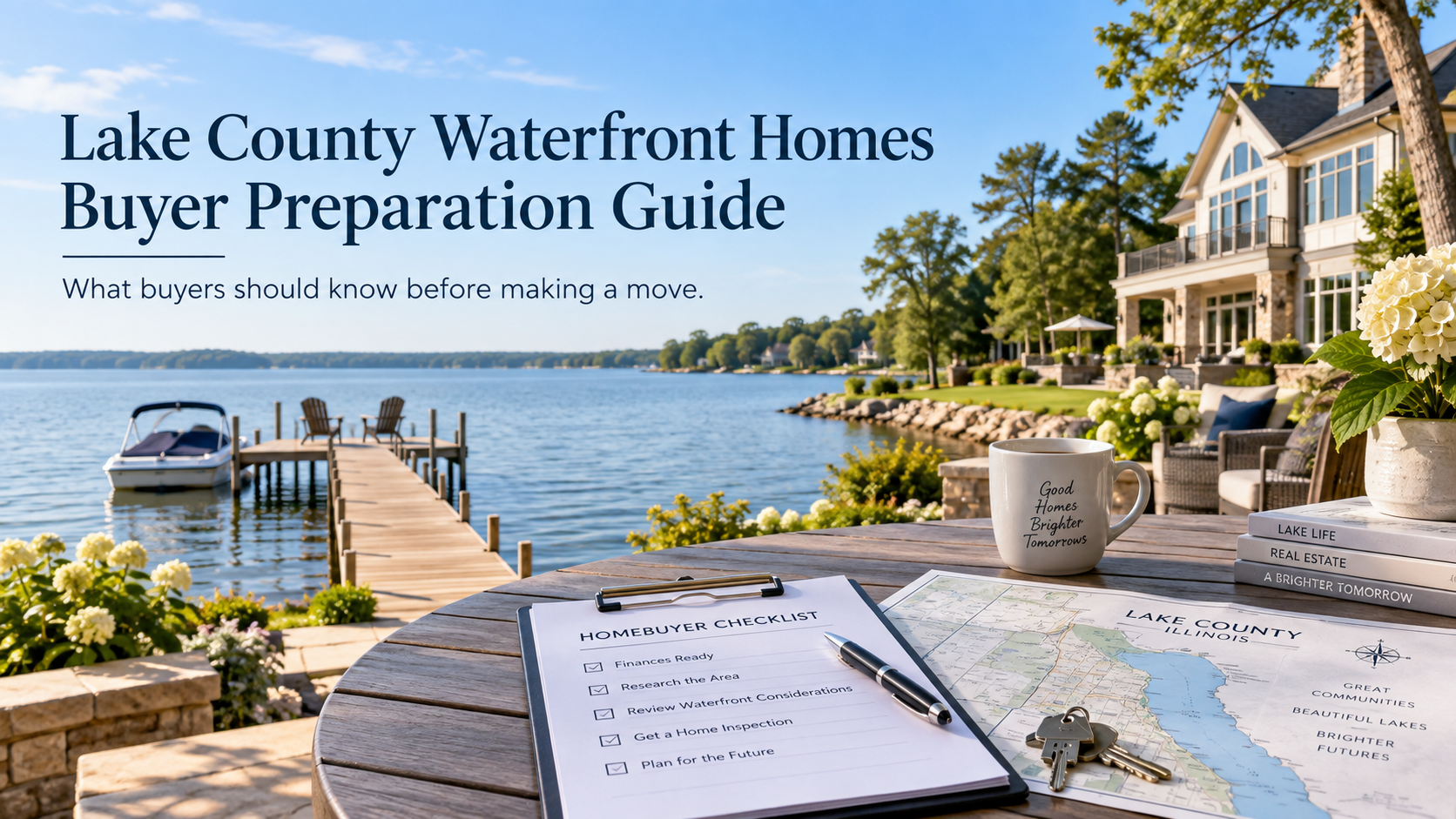
Lake County Waterfront Homes Buyer Preparation Guide
Buying a Lake County waterfront home takes more preparation than buying a typical house because you need to understand the home, shoreline, water access, insurance, dock rules, flood risk, financing, and long-term maintenance. Waterfront living can be exciting. You may picture quiet mornings by the lake, boating on warm days, fishing close to home, or enjoying a peaceful view from your backyard.
But the house itself is only one part of the purchase.
With Lake County waterfront homes, you also need to review the water access, shoreline condition, docks or piers, flood information, insurance needs, surveys, local rules, and ownership responsibilities before you commit.
The Chain O’Lakes area is one reason Lake County attracts waterfront buyers. The Illinois Department of Natural Resources describes Chain O’Lakes State Park as a water-oriented recreation area in northeast Illinois, located in both McHenry and Lake counties, with opportunities for boaters, anglers, and skiers.
Thinking about buying a Lake County waterfront home? Use this guide to prepare before your search begins.
What should buyers know before buying a Lake County waterfront home?
Buyers should know that a Lake County waterfront home is both a residence and a property with water-related rights, responsibilities, risks, and maintenance needs. The view may be beautiful, but the details attached to the property matter just as much.
Before buying, review:
- Direct waterfront versus water view
- Lake access rights
- Property boundaries
- Dock or pier details
- Shoreline condition
- Flood risk
- Insurance requirements
- Financing considerations
- Well, septic, water, and sewer systems
- Maintenance costs
- Association or waterway rules
- Boating access and restrictions
- Resale considerations
The goal is not to make the process stressful. The goal is to understand what you are buying before closing.
Key takeaway: Waterfront homes can offer a special lifestyle, but they require extra due diligence.
Image Suggestion: A buyer standing on a dock with a checklist for access, insurance, inspection, and maintenance.
Alt Text: “Buyer reviewing Lake County waterfront home details before making an offer.”
How should you decide what waterfront living means to you?
You should decide what waterfront living means to you before touring homes because not every waterfront buyer wants the same lifestyle. Some buyers want boating access, while others care more about privacy, views, fishing, kayaking, or outdoor entertaining.
Ask yourself:
- Do I want to boat regularly?
- Do I need direct water access?
- Is a water view enough?
- Do I want space for fishing or kayaking?
- Do I care about swimming access?
- Do I want a dock or pier?
- How much outdoor maintenance am I willing to handle?
- Do I want a quiet setting or active lake environment?
- Will I use the property year-round or seasonally?
Make two lists before touring homes.
Must-haves
These are features that affect whether the property fits your lifestyle, such as direct access, dock availability, boat depth, budget, or parking.
Nice-to-haves
These may include view direction, outdoor entertaining space, upgraded finishes, a newer dock, or a specific home style.
This helps you compare properties clearly instead of being distracted by one great view.
Key takeaway: Define the lifestyle first, then search for the property that supports it.
Image Suggestion: A waterfront buyer comparing boating, fishing, views, outdoor space, and maintenance priorities.
Alt Text: “Defining waterfront lifestyle before buying a Lake County lake home.”
Why should waterfront buyers get financing ready early?
Waterfront buyers should get financing ready early because lenders may need to review the home, property condition, insurance, flood risk, and unique waterfront improvements before final approval. A strong preapproval can help you understand your budget before you fall in love with a property.
A lender may review:
- Income and credit
- Down payment
- Loan type
- Property condition
- Appraisal
- Insurance availability
- Flood zone information
- Association details, if applicable
- Unique property features
You should also plan for costs beyond the down payment.
These may include:
- Home inspection
- Appraisal
- Survey
- Insurance
- Flood insurance, if needed
- Closing costs
- Shoreline maintenance
- Dock or pier maintenance
- Repairs after moving in
- Association fees, when applicable
- Watercraft-related costs, if boating
A waterfront home may fit the purchase budget but still have ownership costs that need careful planning.
Key takeaway: Build your budget around the full cost of ownership, not just the list price.
Image Suggestion: A buyer reviewing preapproval, insurance quotes, flood information, and estimated ownership costs.
Alt Text: “Financing preparation before buying a Lake County waterfront home.”
What is the difference between water view and water access?
A water view means you can see the water, while water access means you have a legal or practical right to use or reach the water in a specific way. Buyers should never assume that a beautiful view includes private access, dock rights, or boating rights.
Ask:
- Does the property have direct waterfront access?
- Where does the property line end?
- Is access private, shared, or association-based?
- Is there an existing dock or pier?
- Can the buyer use, repair, or replace it?
- Are there recorded easements?
- Are there association rules?
- Are boats or certain watercraft restricted?
- Are there public or private launch options nearby?
A survey, title review, attorney review, association documents, and local authority confirmation can help clarify what comes with the property.
Key takeaway: Seeing the water is not the same as owning access to it.
Image Suggestion: A waterfront property diagram showing view, shoreline, property line, dock, and access point.
Alt Text: “Difference between water view and water access for Lake County waterfront homes.”
What should you inspect besides the house?
Waterfront buyers should inspect more than the house because shoreline, drainage, docks, piers, retaining walls, seawalls, steps, decks, and outdoor structures can affect cost and usability. A traditional home inspection is important, but waterfront features deserve extra attention.
Review the condition of:
- Shoreline
- Retaining walls
- Seawalls
- Docks
- Piers
- Steps to the water
- Decks
- Patios
- Drainage
- Outdoor structures
- Landscaping near the shoreline
- Walkways
- Grading
- Basement or crawlspace moisture
- Sump pump systems
Water, ice, storms, changing water levels, and normal wear can affect these areas over time.
A beautiful kitchen may be easier to update than a major shoreline issue. If something looks concerning, ask whether a specialized contractor, inspector, surveyor, engineer, or shoreline professional should evaluate it.
Key takeaway: The waterfront features are part of what you are buying, not just scenery.
Image Suggestion: An inspector reviewing a dock, seawall, shoreline, drainage, and deck at a Lake County lakefront property.
Alt Text: “Waterfront property inspection for shoreline dock seawall and drainage.”
How should buyers check flood risk and insurance?
Buyers should check flood risk and insurance before making a final decision because waterfront location can affect coverage needs, cost, lender requirements, and long-term ownership risk. Do not wait until the week before closing to ask about insurance.
Start by reviewing flood information for the specific address.
FEMA’s FloodSmart program says homeowners can look up their address in the FEMA Flood Map Service Center to learn whether they live, work, or travel in higher-risk flood areas. FloodSmart also explains that most homeowners insurance does not cover flood damage, and flood insurance is specific to flooding.
Ask your insurance provider about:
- Homeowners insurance
- Flood insurance
- Dock or pier coverage
- Other waterfront structures
- Deductibles
- Replacement cost
- Prior claims
- Coverage exclusions
- Lender requirements
- Seasonal or vacant-home considerations
A home does not have to be in a mapped high-risk area to have some flood risk. Discuss the property with your insurance provider and, when needed, local floodplain officials.
Key takeaway: Insurance should be part of your early budget, not a last-minute closing task.
Image Suggestion: A buyer reviewing FEMA flood map information and insurance quotes for a waterfront home.
Alt Text: “Checking flood risk and insurance before buying a Lake County waterfront home.”
Why is a survey important when buying waterfront property?
A survey is important when buying waterfront property because it can help identify property boundaries, improvements, easements, encroachments, and how the lot relates to the shoreline. Waterfront lots can look different in person than they do on paper.
A survey may help clarify:
- Lot boundaries
- Shoreline relationship
- Location of structures
- Fence or shed placement
- Retaining walls
- Dock or access point location
- Easements
- Encroachments
- Setbacks
- Shared access areas
Ask your attorney and surveyor what the survey does and does not show. If waterfront access is central to your purchase, confirm how boundaries and rights are documented.
Key takeaway: A survey helps you understand what you are actually buying.
Image Suggestion: A property survey showing a lakefront lot, shoreline, dock access, easements, and structures.
Alt Text: “Survey for Lake County waterfront property boundaries and access.”
What dock and shoreline rules should buyers review?
Buyers should review dock and shoreline rules before buying because repairs, replacements, new docks, seawalls, landscaping changes, and shoreline work may require approvals or permits. Do not assume you can change the waterfront however you want after closing.
Before buying, ask:
- Is the dock or pier permitted or approved?
- Are there records for shoreline improvements?
- Can the existing dock be repaired?
- Can the dock be replaced?
- Are there size or placement restrictions?
- Are there association rules?
- Are there local or waterway requirements?
- Are seawall repairs regulated?
- Who maintains shared shoreline areas?
- What approvals are needed before construction?
If the home is on or connected to the Chain O’Lakes, waterway rules may also matter. The Fox Waterway Agency states that all watercraft on the Chain O’Lakes must display a valid sticker each year.
Key takeaway: Research dock and shoreline rules before buying, not after you have a project in mind.
Image Suggestion: A dock and shoreline checklist with permits, approvals, maintenance records, and waterway rules.
Alt Text: “Dock and shoreline rules for Lake County waterfront homes.”
Why do water depth and boat access matter?
Water depth and boat access matter because direct shoreline access does not automatically mean the property works for the boat or watercraft you plan to use. If boating is important, the water itself needs to be part of your due diligence.
Ask:
- Is the water deep enough near the property?
- Are there shallow areas or seasonal changes?
- Are there bridges or access limits nearby?
- What type of boat do I plan to use?
- Can I safely enter and leave from the property?
- Is there a public or private launch nearby?
- Are there storage costs?
- Are there wake, speed, or use rules?
- Are there waterway stickers or fees?
- Are there current waterway conditions to monitor?
The ideal property should support the way you plan to use the water. If kayaking, fishing, and quiet views matter more than boating, your priorities may be different from a buyer with a larger motorboat.
Key takeaway: Match the property to your actual water lifestyle, not just the view.
Image Suggestion: A buyer checking boat access, water depth, and nearby bridges before buying a lakefront home.
Alt Text: “Water depth and boat access questions before buying Lake County waterfront property.”
Why should you visit the property more than once?
You should visit a waterfront property more than once because the setting can feel different depending on time of day, weather, season, water activity, and neighborhood traffic. A quiet weekday morning may not feel the same as a sunny weekend afternoon.
When possible, visit at different times and pay attention to:
- Noise
- Boat traffic
- Parking
- Sun exposure
- Privacy
- Neighboring properties
- Outdoor lighting
- Bugs or standing water
- Water activity
- Road traffic
- Nearby public access points
- Weekend versus weekday feel
Ask yourself whether you can picture living there year after year, not just during one beautiful showing.
Key takeaway: Buying the view is easy. Understanding the daily setting takes more thought.
Image Suggestion: A buyer visiting the same Lake County waterfront property at morning, sunset, and weekend activity times.
Alt Text: “Visiting a waterfront property more than once before buying.”
What year-round maintenance should waterfront buyers expect?
Waterfront buyers should expect year-round maintenance involving the home, shoreline, dock or pier, drainage, landscaping, snow and ice, decks, stairs, outdoor structures, and seasonal equipment. The exact work depends on the property.
Ask the seller about maintenance history for:
- Dock or pier
- Shoreline
- Retaining walls
- Decks and patios
- Outdoor stairs
- Drainage
- Landscaping
- Leaves and debris
- Snow and ice
- Sump pump systems
- Waterfront equipment
- Exterior lighting
- Boats, lifts, or storage, if included
Request available records, such as invoices, permits, warranties, service reports, or maintenance receipts.
This is not about discouraging waterfront living. It is about knowing what care the property may need before it becomes yours.
Key takeaway: The better you understand maintenance, the easier it is to budget and plan.
Image Suggestion: A seasonal waterfront maintenance checklist for dock, shoreline, drainage, deck, and snow removal.
Alt Text: “Year-round waterfront maintenance checklist for Lake County home buyers.”
Why should waterfront buyers research the neighborhood too?
Waterfront buyers should research the neighborhood because they are still buying a home in a community, not just a view. Daily life matters after the excitement of the water wears into routine.
Review:
- Grocery stores
- Restaurants
- Medical services
- Parks
- Major roads
- Work commute
- Schools, if relevant
- Internet availability
- Emergency services
- Noise levels
- Traffic patterns
- Parking
- Nearby recreation
- Community rules
Drive the area at different times if possible. Waterfront buyers can become so focused on the lake that they forget to evaluate the everyday location.
Key takeaway: The right property should work for both your waterfront goals and your daily life.
Image Suggestion: A buyer reviewing the neighborhood around a waterfront property, including roads, shops, parks, and services.
Alt Text: “Researching the neighborhood before buying a Lake County waterfront home.”
How should buyers think about resale when buying waterfront property?
Buyers should think about resale by considering features that may appeal to future waterfront buyers, such as usable access, strong views, maintained shoreline structures, parking, outdoor living space, and good property condition. Even if you plan to stay for years, resale matters.
Features that may support future appeal include:
- Convenient water access
- Usable shoreline
- Well-maintained dock or pier
- Attractive lake view
- Functional parking
- Safe access to the water
- Outdoor living space
- Clear property documentation
- Good drainage
- Well-maintained home systems
- Practical layout
- Reasonable ownership costs
Try to separate features that many buyers may value from features that only matter to you.
Key takeaway: Buy a home you love, but understand how future buyers may see it too.
Image Suggestion: A waterfront buyer comparing lifestyle features with long-term resale considerations.
Alt Text: “Resale considerations when buying a Lake County waterfront home.”
How can an AI-Certified real estate agent help waterfront buyers?
An AI-Certified real estate agent can help waterfront buyers organize property questions, compare listing details, summarize inspection issues, track shoreline and access notes, and communicate next steps more clearly. The value is not just the technology. The value is a more organized buying process.
AI-supported tools may help:
- Compare waterfront properties side by side
- Organize lake access questions
- Track dock and shoreline details
- Summarize buyer priorities
- Create inspection checklists
- Organize insurance and flood questions
- Prepare clearer offer discussions
- Summarize follow-up items after showings
Still, technology should support professional judgment, not replace it. A strong local agent brings property knowledge, local context, negotiation experience, and practical guidance when evaluating waterfront homes.
Key takeaway: Smart tools can organize the details, but local expertise helps you decide what those details mean.
Image Suggestion: An AI-Certified real estate agent helping a buyer compare Lake County waterfront homes on a tablet.
Alt Text: “AI-Certified agent helping buy a Lake County waterfront home.”
What is the best Lake County waterfront home buying checklist?
The best Lake County waterfront home buying checklist covers financing, insurance, inspection, survey, water access, docks, shoreline, boating, rules, maintenance, and resale. Use it before making an offer and again during due diligence.
Financing
Confirm your budget, preapproval, loan options, and full ownership costs.
Insurance
Research homeowners insurance, flood insurance, dock coverage, exclusions, deductibles, and lender requirements.
Inspection
Inspect the home and evaluate waterfront features such as shoreline, drainage, docks, piers, decks, and retaining walls.
Survey
Understand property lines, easements, encroachments, access points, and the location of improvements.
Water access
Confirm whether the property has direct, shared, private, or association-based access.
Dock or pier
Review condition, ownership, permits, maintenance records, repair options, and replacement rules.
Shoreline
Look for erosion, drainage concerns, seawall issues, landscaping concerns, and maintenance needs.
Boating
Confirm water depth, access routes, bridges, launches, sticker requirements, and storage options.
Rules
Review association rules, local requirements, shoreline restrictions, and waterway regulations.
Maintenance
Estimate seasonal and long-term maintenance costs for the home and waterfront areas.
Resale
Consider what future buyers may value, including access, views, condition, documentation, and usability.
Key takeaway: A checklist helps you compare waterfront homes with less guesswork and more confidence.
Image Suggestion: A printable Lake County waterfront home buying checklist with financing, insurance, inspection, access, dock, and shoreline categories.
Alt Text: “Lake County waterfront home buying checklist.”
Start your Lake County waterfront home search prepared
Buying a waterfront home is about more than finding a house with a great view. The right purchase should fit your budget, lifestyle, boating plans, maintenance expectations, insurance needs, and long-term goals.
Preparation makes a big difference.
Ask questions. Review the property carefully. Understand the shoreline and water access. Research insurance and financing early. Most importantly, give yourself enough time to understand what makes each waterfront property different.
When you are ready to explore Lake County waterfront homes, working with a real estate professional who understands local waterfront properties can help you identify important details, compare your options, and move forward with greater confidence.
Your waterfront home search should be exciting. With the right preparation, you can spend less time worrying about surprises and more time finding a property that feels right for you.
Frequently Asked Questions
What should I know before buying a waterfront home in Lake County?
Before buying a waterfront home in Lake County, confirm whether the property has direct water access, shared access, or only a water view. Review flood risk, insurance, dock or pier details, shoreline condition, survey information, waterway rules, and year-round maintenance needs. The home itself matters, but the waterfront features can affect cost, use, and resale.
Does a lake view mean I have water access?
No, a lake view does not automatically mean you have water access. A property may look toward the water without including private shoreline rights, dock rights, or boat access. Buyers should verify property boundaries, easements, association rights, and access rules before purchasing.
Should I get flood insurance for a waterfront home?
You should review flood risk and discuss flood insurance with your insurance provider before buying. FloodSmart explains that most homeowners insurance does not cover flood damage, and flood insurance is specific to flooding. Even properties outside mapped high-risk areas can still have some flood risk.
What should be inspected on a waterfront property?
In addition to a general home inspection, buyers should review shoreline areas, seawalls, retaining walls, docks, piers, decks, drainage, outdoor stairs, and any waterfront structures. Depending on the property, you may also need specialized evaluations from a contractor, engineer, surveyor, shoreline professional, or other qualified expert.
Are dock and shoreline changes allowed after buying?
Not always. Dock, pier, seawall, shoreline, landscaping, and waterfront improvement projects may require permits, approvals, or association review depending on the property. Research these rules before buying, especially if your plans involve changing or replacing existing waterfront features.
Internal Link Opportunities
Use these only if you have real live pages on your website:
- Lake County waterfront homes → Link to your Lake County waterfront search page
- Lake County waterfront homes for sale → Link to your listings page
- Chain O Lakes waterfront homes → Link to your Chain O’Lakes buyer page
- buying a waterfront home → Link to your waterfront buyer guide
- waterfront property inspection → Link to your inspection checklist
- waterfront home insurance → Link to your insurance planning article
- Lake County real estate → Link to your Lake County community page
- waterfront property checklist → Link to your downloadable buyer checklist
Sources Used
- Illinois Department of Natural Resources, Chain O’Lakes State Park: https://dnr.illinois.gov/parks/about/park.chainolakes.html
- Lake County, Illinois, Well & Septic Evaluations: https://www.lakecountyil.gov/2474/Well-Septic-Evaluations
- Illinois Emergency Management Agency, Radon Real Estate Information: https://iemaohs.illinois.gov/nrs/radon/realestate.html
- FEMA Flood Map Service Center: https://msc.fema.gov/
- FloodSmart, National Flood Insurance Program: https://www.floodsmart.gov/
- Fox Waterway Agency, User Fee Schedule: https://foxwaterway.com/user-fee-schedule/
Get In Touch

Kevin Kalbach
Broker | Kevin Kalbach Group | Realty Executives Cornerstone
or another way