
Categories
Strategic Home Pricing vs Pricing HighPublished July 19, 2026
Strategic Home Pricing vs Pricing High

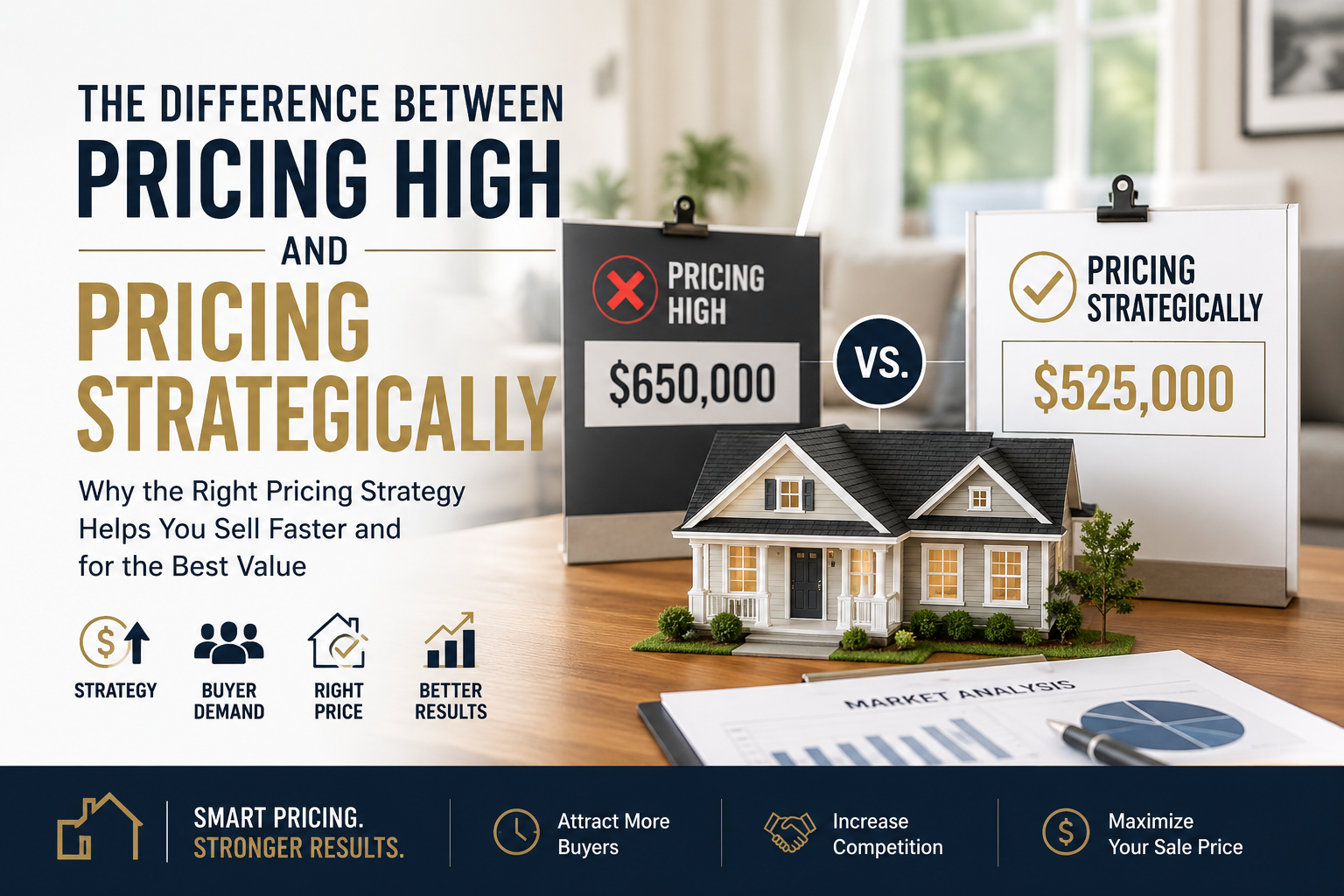
The Difference Between Pricing High and Pricing Strategically
Pricing a home strategically means choosing a listing price based on market data, buyer demand, comparable sales, and your home’s condition, not simply choosing the highest number possible. When it is time to sell your home, one of the biggest decisions you will make is choosing the listing price.
Many homeowners believe that pricing high leaves room for negotiation.
It sounds logical at first. But here is the problem: today’s buyers compare homes quickly, and they usually know when a property feels overpriced.
The Kiplinger home pricing guide explains that sellers should study comparable sales and avoid overpricing because informed buyers can quickly identify inflated values. In other words, pricing high and pricing strategically are not the same thing.
A strategic pricing plan can attract serious buyers, create stronger early interest, and support better negotiating power. Let’s look at why.
What does pricing high really mean when selling a home?
Pricing high means listing a home above its likely current market value because the seller hopes a buyer will pay more or negotiate down from the higher number. While understandable, this approach can reduce buyer interest if the price feels unrealistic.
Many sellers price high because they think:
- Buyers will negotiate anyway
- They can always reduce the price later
- Their home is worth more because of personal memories
- Recent improvements should add more value
- Starting high protects them from leaving money on the table
- The “right buyer” may be willing to pay extra
These reasons are emotional and common. But buyers usually compare your home with other active listings and recent sales before deciding whether to schedule a showing.
If similar homes offer more value at a lower price, buyers may skip your listing entirely.
Key takeaway: Pricing high may feel protective, but it can make buyers question the value before they ever visit.
Image Suggestion: A seller looking at an overpriced listing with fewer online views than competing homes.
Alt Text: “Seller reviewing an overpriced home listing with low buyer interest.”
What is strategic home pricing?
Strategic home pricing is the process of setting a listing price based on facts, local market data, buyer behavior, and the home’s real competitive position. The goal is not to list as high as possible. The goal is to attract the right buyers and maximize the final result.
A real estate professional may review:
- Recent comparable sales
- Active competing listings
- Pending sales, when available
- Buyer demand
- Inventory levels
- Days on market
- Condition and upgrades
- Location and lot features
- Property layout
- Price reductions nearby
- Current mortgage rate environment
A comparative market analysis, often called a CMA, helps compare your home with similar homes that recently sold and homes currently competing for buyer attention. Investopedia explains that a CMA is one way homeowners can estimate value by comparing similar properties, while appraisals and online valuation tools are other valuation methods with different strengths and limits. Investopedia, How Much Is My Home Worth?
Would you rather have one uncertain buyer or several serious buyers paying attention at the same time?
That is what strategic pricing is designed to create.
Key takeaway: Strategic pricing is not about underpricing. It is about positioning your home to compete effectively.
Image Suggestion: A pricing strategy worksheet showing comparable sales, active listings, and suggested list price.
Alt Text: “Strategic home pricing worksheet with comparable sales and market data.”
Why can overpricing a home cost sellers more?
Overpricing can cost sellers more because it may reduce showings, increase days on market, create buyer doubt, and lead to price reductions later. A home that sits too long can lose momentum.
Many sellers assume a higher list price means a higher final sale price.
Often, the opposite happens.
When a home is overpriced, buyers may think:
- The seller is unrealistic
- The home is not worth the asking price
- Better options exist nearby
- Something may be wrong if it sits too long
- They should wait for a price reduction
The Wall Street Journal reported that overpriced homes have been lingering longer in the market and often need price cuts before selling, especially when buyers are sensitive to affordability. (The Wall Street Journal)
Price reductions are not always bad, but repeated reductions can change the way buyers view the listing. Instead of feeling fresh and desirable, the home may begin to feel stale.
Key takeaway: Overpricing can turn early excitement into hesitation.
Image Suggestion: A listing timeline showing high initial price, long days on market, and later price reductions.
Alt Text: “Overpriced home listing timeline showing price reductions and longer days on market.”
Why does strategic pricing create better seller results?
Strategic pricing can create better seller results by attracting more qualified buyers early, increasing showing activity, and improving the chance of stronger offers. The best pricing strategy is designed to create buyer confidence, not buyer resistance.
A well-priced home can generate:
- More online views
- More showing requests
- More buyer interest
- Better offer activity
- Stronger negotiating position
- Fewer unnecessary price reductions
- Faster decision-making from buyers
A Washington Post real estate report noted that effective pricing often comes from detailed market research and comparable sales analysis, and that homes priced appropriately tend to sell faster. (The Washington Post)
Strategic pricing is not about selling for less. It is about creating the conditions that help the market respond.
When buyers believe a home is priced fairly, they are more likely to tour it, discuss it, compare it seriously, and make an offer.
Key takeaway: Strategic pricing helps buyers feel urgency for the right reason: value.
Image Suggestion: A seller reviewing multiple showing requests after launching with a strategic listing price.
Alt Text: “Strategically priced home attracting buyer interest after listing.”
Why do the first few weeks on the market matter most?
The first few weeks matter because new listings often receive the most attention from active buyers watching the market. If a home is priced incorrectly at launch, sellers may miss their best window to create interest.
Buyers who are already searching often receive alerts when a new listing matches their criteria. That means your first days and weeks on the market can be powerful.
If the home launches too high, buyers may ignore it. Even if you reduce the price later, some buyers may not return.
This is why sellers should prepare pricing before the listing goes live. A strong launch includes:
- Accurate pricing
- Professional presentation
- Clean listing photos
- Clear listing details
- Strong showing access
- Local market awareness
- A plan for early feedback
Key takeaway: Pricing correctly from day one helps protect your strongest marketing window.
Image Suggestion: A new listing launch calendar showing the first two weeks as the highest-interest period.
Alt Text: “First few weeks on the market are important for home sellers.”
How do emotions affect a seller’s pricing decision?
Emotions affect pricing because sellers often connect value with memories, improvements, and personal attachment. Buyers, however, usually compare the home to other options based on price, condition, location, and features.
It is completely normal to feel emotionally attached to your home.
You may have celebrated birthdays there. Raised a family there. Completed renovations. Worked hard to maintain it. Created memories that cannot be priced.
But buyers see the home differently.
They are comparing:
- Your home versus similar homes for sale
- Your price versus recent sold prices
- Your updates versus competing updates
- Your condition versus inspection concerns
- Your location versus other neighborhoods
- Your monthly payment versus their budget
That does not mean your memories do not matter. It means market value is determined by buyer behavior, not personal history.
Key takeaway: Strategic pricing helps separate emotional value from market value.
Image Suggestion: A seller looking through family photos while an agent reviews market data nearby.
Alt Text: “Seller balancing emotional value and market value before pricing a home.”
How does a comparative market analysis help price a home?
A comparative market analysis helps price a home by comparing it with similar recently sold homes and current competing listings. It gives sellers a clearer view of how buyers may judge the home’s value.
A CMA may review:
- Recent sold homes
- Active listings
- Pending sales
- Price changes
- Days on market
- Square footage
- Lot size
- Bedrooms and bathrooms
- Condition and updates
- Location differences
- Garage, basement, pool, or outdoor features
The sales comparison approach is widely used in real estate valuation because it compares the property with similar properties that recently sold, adjusting for features such as size, condition, location, lot size, and other differences. Sales Comparison Approach
A CMA is not the same as a formal appraisal. However, it can help sellers understand the likely buyer perspective before choosing a listing price.
Key takeaway: A good CMA helps sellers price with evidence instead of guesswork.
Image Suggestion: A comparative market analysis report showing recently sold homes near the seller’s property.
Alt Text: “Comparative market analysis used to price a home before listing.”
Should sellers leave room for negotiation?
Sellers can leave room for negotiation, but the list price still needs to make sense to buyers. If the price is too high, buyers may never reach the negotiation stage.
This is where many sellers get stuck. They think, “Let’s list high because buyers will offer less anyway.”
But buyers do not always negotiate. Sometimes they just move on.
A smarter approach is to price within a realistic range and use negotiation strategy through terms, timing, concessions, and offer review.
For example, your agent may help you evaluate:
- Offer price
- Closing timeline
- Financing strength
- Inspection terms
- Appraisal risk
- Contingencies
- Buyer flexibility
- Seller credits
- Possession timing
Key takeaway: The best negotiation strategy starts with a price that gets buyers through the door.
Image Suggestion: A seller and agent reviewing offer terms beyond price.
Alt Text: “Seller reviewing negotiation terms after pricing a home strategically.”
How can days on market affect a home’s final sale?
Days on market can affect a home’s final sale because buyers may see a long listing time as a sign that the price is too high or the home has unresolved issues. Longer market time can reduce urgency.
Days on market, often called DOM, measures how long a listing has been active before an offer is accepted or the listing ends. A high DOM can influence buyer perception and may factor into pricing strategy. Days on Market
When a listing sits, buyers may ask:
- Why has it not sold?
- Is the price too high?
- Did another buyer back out?
- Are there inspection concerns?
- Will the seller accept less now?
This is why the first pricing decision matters. A well-positioned home can create more urgency early, while an overpriced home may need to overcome buyer skepticism later.
Key takeaway: Days on market can become part of the negotiation before buyers even make an offer.
Image Suggestion: A listing dashboard showing days on market increasing over time.
Alt Text: “Days on market affecting buyer perception of a home listing.”
How can an AI-Certified real estate agent help with strategic pricing?
An AI-Certified real estate agent can help sellers organize pricing information, compare market activity more efficiently, and create clearer marketing communication. The value is not just the technology. The value is how smart tools support better seller strategy.
Pricing a home requires local experience, market context, buyer behavior, and professional judgment. AI-supported tools may help organize comparable sales, summarize buyer feedback, prepare listing descriptions, compare property features, and make the marketing process more efficient.
Still, pricing should not rely on automated estimates alone. A strong agent brings local knowledge, property-specific insight, negotiation skill, and human judgment to the strategy.
Key takeaway: Smart tools can support strategic pricing, but local expertise should guide the final decision.
Image Suggestion: An AI-Certified real estate agent reviewing a pricing strategy dashboard with a seller.
Alt Text: “AI-Certified real estate agent helping seller review strategic home pricing.”
What is the smartest way to price a home before listing?
The smartest way to price a home is to review comparable sales, analyze current competition, consider buyer demand, evaluate the home’s condition, and choose a price that positions the home competitively from the start. The goal is to attract serious buyers, not just test the market.
Before choosing a list price, sellers should ask:
- What similar homes recently sold nearby?
- What homes are currently competing with mine?
- How does my condition compare?
- What upgrades matter to buyers?
- What price range are buyers searching in?
- How quickly are homes selling locally?
- Are price reductions common right now?
- What feedback are buyers giving on similar homes?
- What is my timeline?
- How much risk am I comfortable taking?
Key takeaway: Strategic pricing is a decision based on data, timing, competition, and buyer psychology.
Image Suggestion: A seller reviewing a final pricing checklist before listing the home.
Alt Text: “Seller using strategic pricing checklist before listing a home.”
Price smart and sell with confidence
Choosing the right listing price is one of the most important decisions you will make during your home-selling journey. Pricing high may feel safer, but it can reduce buyer interest, increase days on market, and create pressure for price reductions later.
Strategic pricing, on the other hand, helps your home enter the market with purpose. It can attract serious buyers, support stronger interest, and help you negotiate from a better position.
If you are thinking about selling your home, talk with a trusted local real estate professional who understands your market and can help you develop a pricing strategy that works for today’s buyers.
Frequently Asked Questions
What is the difference between pricing high and pricing strategically?
Pricing high means listing above likely market value and hoping a buyer will pay more or negotiate down. Pricing strategically means choosing a listing price based on comparable sales, current competition, buyer demand, condition, and local market behavior. Strategic pricing is designed to attract serious buyers and support a stronger overall result.
Is it bad to price a home high at first?
Pricing a home too high can reduce buyer interest, increase days on market, and lead to price reductions later. Some sellers believe they can always lower the price, but buyers may form early opinions and skip the listing. A better approach is to launch with a price that makes sense compared with similar homes.
Does strategic pricing mean selling for less?
No, strategic pricing does not mean selling for less. It means positioning the home at a price that encourages serious buyers to engage. When buyers see strong value, the home may receive more interest, more showings, and potentially stronger offers.
How does a real estate agent determine the right listing price?
A real estate agent often prepares a comparative market analysis by reviewing similar recently sold homes, active listings, days on market, price reductions, property condition, and local demand. This helps estimate how buyers may view the home. The final pricing strategy should also consider the seller’s timeline and market conditions.
What happens if my home sits on the market too long?
If a home sits too long, buyers may start wondering whether it is overpriced or if something is wrong with the property. Longer days on market can reduce urgency and may weaken the seller’s negotiating position. Strategic pricing from the beginning can help avoid that problem.
Internal Link Opportunities
Use these only if you have real live pages on your website:
- pricing your house to sell → Link to your home valuation page
- comparative market analysis → Link to your CMA or seller consultation page
- home selling strategy → Link to your seller guide
- pre-listing checklist → Link to your preparation checklist
- sell your home faster → Link to your marketing strategy article
- trusted local real estate professional → Link to your contact page
Sources Used
- Kiplinger, How to Set the Price to Sell Your Home
- Investopedia, How Much Is My Home Worth?
- The Wall Street Journal, When Home Sellers Set Prices Too High, They’re Paying for It
- The Washington Post, Offer High? Offer Low? What’s a Buyer to Do?
- Sales Comparison Approach
- Days on Market
Get In Touch

Kevin Kalbach
Broker | Kevin Kalbach Group | Realty Executives Cornerstone
or another way