
Categories
What Happens After Your Home Goes Under ContractPublished July 28, 2026
What Happens After Your Home Goes Under Contract

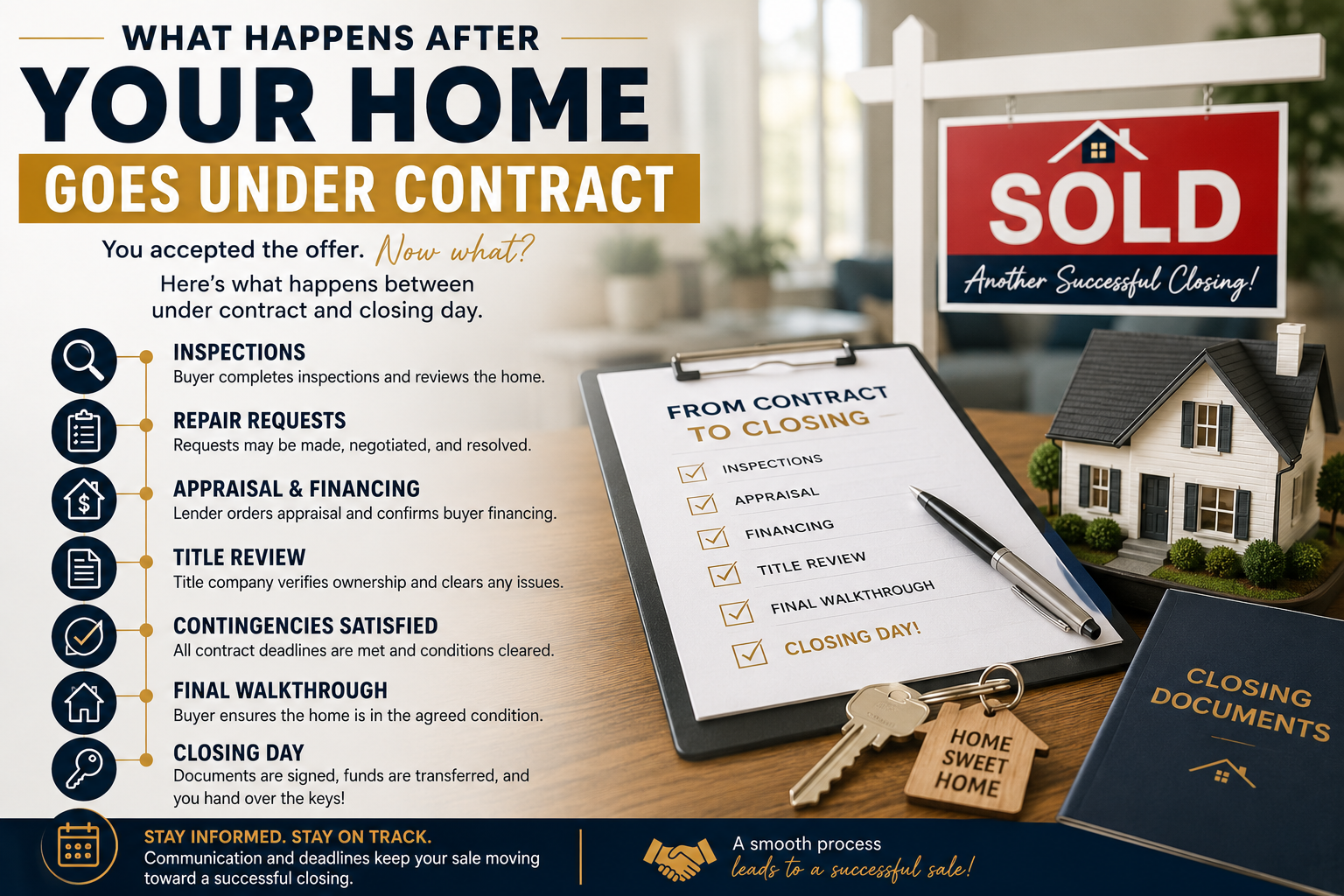
What Happens After Your Home Goes Under Contract
When your home goes under contract, the buyer and seller have signed a purchase agreement, but the sale is not complete until inspections, appraisal, financing, title review, final walkthrough, and closing are finished. Accepting an offer is a major step in the home-selling process, and it is normal to feel excited, relieved, and ready to celebrate.
But this is not the finish line yet.
The under-contract period is where the transaction moves from accepted offer to final closing. During this time, the buyer may inspect the home, the lender may order an appraisal, title may be reviewed, repairs may be negotiated, and both sides must follow contract deadlines.
The Consumer Financial Protection Bureau explains that closing is when the buyer becomes legally responsible for the mortgage loan, and that loan-related steps continue before closing. For sellers, that means the accepted offer still needs to move through several important stages before the home is officially sold.
In this guide, you will learn what happens after your home goes under contract, what sellers should expect, and how to keep the sale moving toward a successful closing.
What does under contract mean when selling a home?
A home is under contract when the seller has accepted the buyer’s offer and both parties have signed a purchase agreement. The sale is in progress, but it is not final until all contract terms are completed and closing occurs.
The purchase agreement usually includes:
- Sale price
- Closing date
- Earnest money amount
- Financing terms
- Inspection rights
- Appraisal terms
- Title requirements
- Included fixtures or appliances
- Seller credits, if any
- Contingency deadlines
- Possession terms
Many contracts include conditions that must be satisfied before closing. These conditions are often called contingencies.
Common contingencies may include:
- Home inspection
- Buyer financing
- Property appraisal
- Title review
- Sale of the buyer’s current home
- HOA or document review
- Attorney review, where applicable
Key takeaway: Under contract means the sale is moving forward, but the home is not officially sold yet.
Image Suggestion: A signed purchase agreement with a “Under Contract” sign and house keys nearby.
Alt Text: “Home under contract after seller accepts a buyer offer.”
What happens with earnest money after the contract is signed?
After the contract is signed, the buyer usually deposits earnest money to show they are serious about purchasing the home. This money is typically held by a title company, attorney, brokerage, or escrow company until closing.
The amount and deadline are usually listed in the purchase agreement.
If the sale closes, earnest money is generally applied toward the buyer’s down payment, closing costs, or other amounts due at closing. If the sale is canceled, what happens to the deposit depends on the contract terms and why the transaction ended.
For example, the outcome may depend on whether:
- The buyer canceled within an allowed contingency period
- A deadline was missed
- Financing was denied
- The inspection negotiation failed
- The appraisal came in low
- One party breached the contract
Key takeaway: Earnest money is serious, but the contract controls what happens to it if the deal does not close.
Image Suggestion: A buyer’s earnest money deposit receipt beside a signed purchase agreement.
Alt Text: “Earnest money deposit after a home goes under contract.”
What happens during the buyer’s home inspection?
During the buyer’s home inspection, a professional inspector reviews the home’s visible and accessible systems and components. The inspection helps the buyer better understand the home’s condition before closing.
A home inspector may examine:
- Roof
- Foundation
- Plumbing
- Electrical system
- Heating and cooling equipment
- Windows and doors
- Attic and crawl space
- Appliances, when included
- Drainage concerns
- Safety items
- Signs of water damage
The HUD home inspection guide explains that a home inspection provides detailed information about a home’s condition, and that it is different from an appraisal. Sellers should expect that even well-maintained homes may have inspection notes.
No home is perfect. An inspection report does not automatically mean the sale is in trouble. It simply gives the buyer information.
Key takeaway: The inspection helps the buyer understand condition, and it may lead to repair requests or further negotiation.
Image Suggestion: A home inspector checking a furnace while the buyer’s agent takes notes.
Alt Text: “Home inspection after a seller accepts an offer.”
How should sellers respond to repair requests after inspection?
Sellers should respond to repair requests by reviewing the contract, focusing on important issues, and deciding whether to repair, offer a credit, reduce the price, negotiate, or decline the request. Not every inspection item requires the same response.
After the inspection, the buyer may ask for repairs, credits, or other changes. Sellers do not always have to agree to every request, but the right response depends on the contract, market conditions, and the seriousness of the issue.
Possible seller responses include:
- Completing requested repairs
- Agreeing to some repairs but not others
- Offering a closing credit, if allowed
- Reducing the purchase price
- Declining the request
- Negotiating another solution
Major issues often receive more attention than small cosmetic concerns. These may include:
- Safety concerns
- Structural concerns
- Roof problems
- Active leaks
- Electrical problems
- Plumbing defects
- Heating or cooling failure
- Water damage
If repairs are needed, the Federal Trade Commission recommends checking references, comparing written estimates, reviewing written contracts, and avoiding large upfront payments when hiring contractors.
Key takeaway: Repair negotiations should focus on meaningful issues, not every small imperfection.
Image Suggestion: A seller and agent reviewing a buyer’s inspection repair request.
Alt Text: “Seller reviewing repair requests after home inspection.”
What happens when the buyer’s lender orders an appraisal?
When the buyer is using a mortgage, the lender usually orders an appraisal to estimate the property’s value. The lender wants to confirm that the home supports the loan amount.
An appraiser may review:
- Home size
- Location
- Condition
- Features
- Upgrades
- Lot size
- Comparable sales
- Local market activity
The Consumer Financial Protection Bureau explains that an appraisal is a written document showing an opinion of how much the property is worth. If the appraisal meets or exceeds the purchase price, the transaction may continue more smoothly.
If the appraisal comes in low, the buyer and seller may need to review options.
Possible options may include:
- Lowering the purchase price
- Buyer bringing additional funds
- Buyer and seller splitting the gap
- Requesting a reconsideration of value through the lender
- Seeking another appraisal, if allowed
- Canceling the contract, depending on the terms
Key takeaway: The appraisal can affect buyer financing, so sellers should take it seriously.
Image Suggestion: A licensed appraiser measuring a home exterior after it goes under contract.
Alt Text: “Home appraisal after a property goes under contract.”
What happens while the buyer’s loan is being approved?
While the buyer’s loan is being approved, the lender continues reviewing the buyer’s income, employment, credit, assets, debts, bank statements, and loan conditions. Even a pre-approved buyer still has work to complete before closing.
The seller may not be directly involved in the buyer’s financing process, but financing delays can affect the closing schedule.
Buyers are usually advised to avoid major financial changes during this period, such as:
- Opening new credit accounts
- Buying a car
- Making large unexplained deposits
- Changing jobs without discussing it with the lender
- Increasing debt
- Missing payments
- Moving money without documentation
The CFPB explains that before closing, borrowers receive a Closing Disclosure with final loan terms and costs, and they should compare it with their Loan Estimate. For sellers, this is a reminder that the buyer’s financing continues right up to closing.
Key takeaway: Buyer financing can affect the seller’s timeline, even when the buyer was pre-approved.
Image Suggestion: A buyer’s lender reviewing loan documents while the seller tracks contract deadlines.
Alt Text: “Buyer financing process after a home goes under contract.”
What happens during the title review?
During the title review, a title company or attorney reviews public records to confirm ownership and identify issues that may need to be resolved before closing. Clear title is an important part of transferring ownership.
Title issues may include:
- Unpaid liens
- Ownership disputes
- Unreleased mortgages
- Errors in public records
- Unpaid taxes
- Judgments
- Easement concerns
- Boundary concerns
- Missing signatures from prior transactions
Many title problems can be resolved before closing, but some take time. Sellers may need to provide documents, pay an outstanding balance, sign paperwork, or work with the title company to clear an issue.
Key takeaway: Responding quickly to title requests can help prevent closing delays.
Image Suggestion: A seller reviewing title documents with a closing professional.
Alt Text: “Title review during the home selling process after going under contract.”
What should sellers do if they agreed to repairs?
If sellers agreed to repairs, they should complete the work by the contract deadline, use qualified professionals when needed, and keep receipts, invoices, warranties, and photos. Late or incomplete repairs can create stress before closing.
Agreed repairs should be handled carefully. Do not wait until the last minute.
Sellers should:
- Confirm repair terms in writing
- Schedule contractors quickly
- Use qualified professionals for specialized work
- Keep receipts and invoices
- Save warranties
- Take before-and-after photos
- Confirm permits when required
- Avoid changing the scope without agreement
- Finish before the final walkthrough
The buyer may ask for proof that repairs were completed. Some repairs may also be rechecked before closing.
Key takeaway: Repair follow-through helps protect the closing timeline.
Image Suggestion: A contractor completing an agreed repair while the seller keeps the invoice.
Alt Text: “Seller completing agreed repairs before closing.”
What does it mean when contingencies are removed?
When contingencies are removed or satisfied, it means certain contract conditions have been completed or waived. As major contingencies are resolved, the transaction usually becomes more likely to close.
Common contingency milestones may include:
- Inspection period completed
- Repair agreement reached
- Appraisal accepted
- Financing approved
- Title cleared
- HOA documents reviewed
- Buyer’s home sale contingency satisfied
- Attorney review completed, where applicable
A home being under contract is a positive sign, but it is not a guarantee. Sellers should continue to follow the purchase agreement until the sale is officially closed.
Key takeaway: Each completed contingency is a step closer to closing, but sellers should stay careful until everything is signed and funded.
Image Suggestion: A contract checklist showing inspection, appraisal, financing, title, and closing items completed.
Alt Text: “Home sale contingencies being removed before closing.”
How should sellers prepare to move after going under contract?
Sellers should prepare to move by packing early, arranging utilities, removing personal items, planning movers, and confirming what stays with the home. The time between contract and closing can pass quickly.
The home should usually be empty and clean by the date stated in the contract unless another arrangement has been made.
Sellers should plan for:
- Packing
- Moving company scheduling
- Utility transfers or shutoffs
- Address changes
- Trash removal
- Cleaning
- Pet arrangements
- Key and garage opener collection
- Final personal property review
- Possession timing
Do not remove items that are included in the sale. Fixtures such as attached lighting, built-in shelves, curtain rods, mounted items, and certain appliances may need to stay depending on the contract.
When in doubt, ask your agent before removing anything.
Key takeaway: Moving preparation should begin early, but sellers must follow the contract on included items and possession timing.
Image Suggestion: A seller packing boxes while reviewing a list of included fixtures and appliances.
Alt Text: “Seller preparing to move after home goes under contract.”
What happens during the final walkthrough?
During the final walkthrough, the buyer checks that the home is in the expected condition before closing. It is not usually a full inspection, but it helps confirm the property is ready for possession.
The buyer may check that:
- Agreed repairs were completed
- The property has not been damaged
- Included appliances and fixtures remain
- Personal belongings were removed
- Trash was removed
- Plumbing, lights, and major systems still work
- The home is clean and ready
- No major changes were made without agreement
Sellers should avoid making major changes after going under contract unless the buyer agrees in writing.
Key takeaway: A smooth final walkthrough helps keep closing day on track.
Image Suggestion: A buyer and agent checking a clean, empty home before closing.
Alt Text: “Final walkthrough before closing on a home sale.”
What closing documents should sellers review?
Sellers should review closing documents that show the final financial details of the sale, including the purchase price, mortgage payoff, taxes, commissions, credits, title fees, and net proceeds. Errors are easier to fix before signing.
Before closing, sellers may receive a settlement statement or closing statement. This document outlines the money coming in and going out.
Review items such as:
- Purchase price
- Mortgage payoff
- Property tax adjustments
- Real estate commissions
- Seller credits
- Repair credits
- Title fees
- Recording fees
- HOA fees, if applicable
- Escrow or closing fees
- Seller net proceeds
Ask questions if something looks incorrect or unclear.
Key takeaway: Review your seller closing figures carefully before signing.
Image Suggestion: A seller reviewing a settlement statement with a calculator and closing folder.
Alt Text: “Seller reviewing closing documents before selling a home.”
What happens on closing day?
On closing day, the seller signs documents to transfer ownership, the buyer signs loan and purchase documents, funds are distributed, and the deed is recorded according to local closing procedures. Once everything is complete, the sale is officially closed.
Depending on the location, buyer and seller may sign at different times or in different places. Some closings involve an attorney, title company, escrow company, or settlement agent.
The seller may receive proceeds by wire or check according to the closing arrangements.
Closing is complete when the required documents are signed, funds are confirmed, and recording or disbursement requirements are met.
Key takeaway: Closing day is when the under-contract period becomes a completed sale.
Image Suggestion: A seller signing closing documents with house keys on the table.
Alt Text: “Seller signing closing documents after home goes under contract.”
When does the buyer get the keys?
The buyer usually gets the keys after closing, but the exact timing depends on the purchase agreement and local practice. Possession should never be assumed without written terms.
In some transactions, the seller moves out before closing and the buyer receives the keys shortly after closing is complete. In others, the seller may have an agreed period to remain in the home after closing.
This may be called:
- Post-closing possession
- Seller possession after closing
- Rent-back agreement
- Use and occupancy agreement
Never assume you can stay after closing without a written agreement. The contract should clearly explain when the buyer takes possession.
Key takeaway: Key handoff depends on the contract, not assumptions.
Image Suggestion: A seller handing house keys to a real estate agent after closing.
Alt Text: “Buyer receives keys after home closing.”
Can a sale fall through after going under contract?
Yes, a sale can fall through after going under contract if financing is denied, inspection negotiations fail, the appraisal is too low, title issues cannot be resolved, or one party misses contract deadlines. Under contract does not always mean guaranteed closing.
Common reasons a sale may fall through include:
- Buyer financing denial
- Low appraisal
- Inspection disputes
- Title problems
- Buyer’s home sale issue
- Missed deadlines
- Insurance problems
- Unresolved repair issues
- Final walkthrough problems
- Contract disagreements
The rights of the buyer and seller depend on the purchase agreement and local law. This is why deadlines, documentation, communication, and professional guidance matter.
Key takeaway: A sale can still fall through before closing, but good preparation can reduce avoidable problems.
Image Suggestion: A seller and agent reviewing possible contract risks before closing.
Alt Text: “Seller understanding why a home sale can fall through under contract.”
How can sellers help keep the sale on track?
Sellers can help keep the sale on track by responding quickly, meeting deadlines, completing agreed repairs, keeping the home in good condition, avoiding unauthorized changes, and staying in contact with their real estate agent.
A seller cannot control every part of the transaction, especially the buyer’s financing. But a seller can reduce many avoidable problems.
Sellers should:
- Respond quickly to document requests
- Complete agreed repairs on time
- Keep receipts and records
- Maintain the home until closing
- Avoid removing included items
- Keep utilities on when needed
- Make the final walkthrough easy
- Review closing documents early
- Ask questions quickly
- Stay in communication with the agent
Key takeaway: The best sellers stay organized, responsive, and contract-focused until the sale is complete.
Image Suggestion: A seller using a contract-to-closing checklist to stay organized.
Alt Text: “Seller checklist for keeping a home sale on track after going under contract.”
How can an AI-Certified real estate agent help after your home goes under contract?
An AI-Certified real estate agent can help sellers stay organized after going under contract by tracking deadlines, summarizing next steps, organizing repair items, and improving communication. The value is not just the technology. The value is clearer service during a detailed process.
The under-contract period can involve inspections, appraisal questions, repair negotiations, title requests, closing documents, deadlines, and moving logistics. AI-supported tools may help organize timelines, summarize buyer feedback, prepare task lists, and keep communication more efficient.
Still, technology should support professional judgment, not replace it. A strong agent brings local contract knowledge, negotiation experience, market understanding, and practical guidance from accepted offer to closing.
Key takeaway: Smart tools can support a smoother process, but trusted local expertise guides the transaction.
Image Suggestion: An AI-Certified real estate agent reviewing a contract-to-closing timeline with a seller on a tablet.
Alt Text: “AI-Certified real estate agent helping seller after home goes under contract.”
What is the seller’s under-contract checklist?
A seller’s under-contract checklist helps organize the steps from accepted offer to closing. It should cover earnest money, inspection, repairs, appraisal, title, moving, final walkthrough, and closing documents.
Use this simple checklist:
- Confirm the signed purchase agreement
- Track all contract deadlines
- Confirm earnest money deposit status
- Prepare for buyer inspection
- Review repair requests carefully
- Complete agreed repairs on time
- Keep repair receipts and warranties
- Prepare for appraisal access
- Respond quickly to title requests
- Start packing and planning your move
- Confirm what stays with the home
- Keep utilities on as needed
- Prepare for final walkthrough
- Review seller closing documents
- Confirm possession and key handoff
- Stay in contact with your agent
Key takeaway: A clear checklist helps sellers move from contract to closing with less stress.
Image Suggestion: A printable seller under-contract checklist with inspection, appraisal, title, repairs, and closing steps.
Alt Text: “Seller under-contract checklist from accepted offer to closing.”
Move from contract to closing with confidence
Going under contract is exciting, but there are still several important steps before the home is officially sold. The inspection, appraisal, financing, title review, repairs, final walkthrough, and closing all play a role.
The more you understand the process, the easier it is to stay calm and prepared.
Are you preparing to sell your home or reviewing an offer? Work with a knowledgeable local real estate professional who can explain the contract, protect your interests, and guide you from accepted offer to a successful closing.
Frequently Asked Questions
What does under contract mean when selling a home?
Under contract means the seller has accepted a buyer’s offer and both sides have signed a purchase agreement. The sale is moving forward, but it is not final yet. Inspections, appraisal, financing, title review, repairs, final walkthrough, and closing may still need to happen.
Can a home sale fall through after going under contract?
Yes, a home sale can fall through after going under contract. Common reasons include buyer financing problems, a low appraisal, inspection negotiations, title issues, or missed contract deadlines. The purchase agreement controls the rights and responsibilities of each party.
What happens after the buyer’s home inspection?
After the buyer’s home inspection, the buyer may accept the home as it is, request repairs, ask for a credit, renegotiate, or cancel if the contract allows it. Sellers can review the request and decide how to respond. Your real estate agent can help you focus on meaningful issues instead of small cosmetic items.
What happens if the appraisal is lower than the purchase price?
If the appraisal is lower than the purchase price, the buyer and seller may need to negotiate. Options may include lowering the price, the buyer bringing more cash, splitting the difference, or requesting a reconsideration of value through the lender. The available options depend on the contract and loan requirements.
When does the seller receive money after closing?
The seller usually receives proceeds after closing documents are signed, funds are confirmed, and the transaction is completed according to local closing procedures. The exact timing depends on the title company, escrow company, attorney, lender funding, and local rules. Ask your closing professional how and when proceeds will be delivered.
Internal Link Opportunities
Use these only if you have real live pages on your website:
- home under contract → Link to your contract-to-closing guide
- home inspection → Link to your seller inspection guide
- home appraisal → Link to your appraisal article
- seller closing checklist → Link to your closing checklist
- final walkthrough → Link to your final walkthrough guide
- knowledgeable local real estate professional → Link to your contact page
Sources Used
- Consumer Financial Protection Bureau, Close on Your New Home
- Consumer Financial Protection Bureau, Review Documents Before Closing
- Consumer Financial Protection Bureau, What Are Appraisals and Why Do I Need To Look at Them?
- HUD Exchange, For Your Protection: Get a Home Inspection
- Federal Trade Commission, How To Avoid a Home Improvement Scam
Get In Touch

Kevin Kalbach
Broker | Kevin Kalbach Group | Realty Executives Cornerstone
or another way